
Blood pressure, cholesterol, glucose, and other biomarkers get most of the attention when we talk about longevity. But one surprisingly simple measurement may reveal more about your long-term health than you would expect.
It requires no blood draw, no scan, and almost no time.
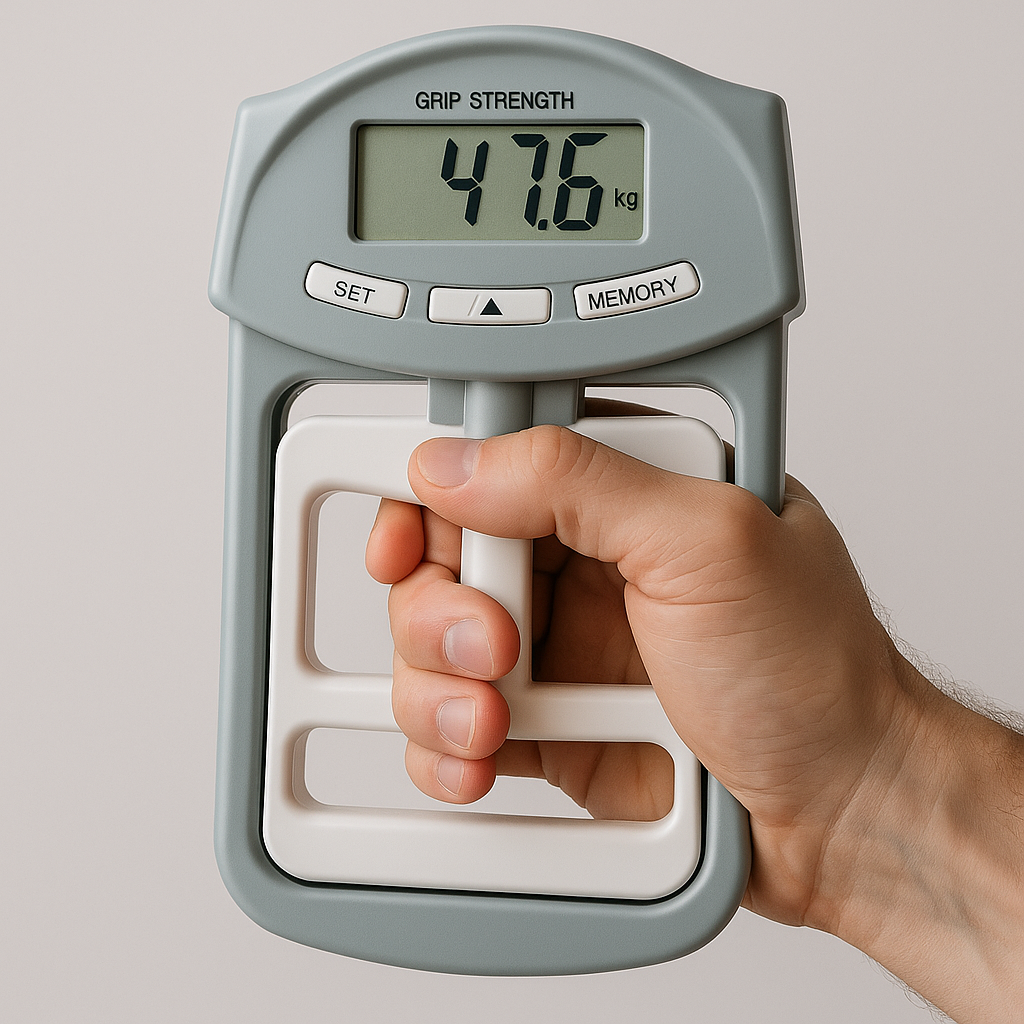
You simply squeeze a device called a handgrip dynamometer as hard as you can.
And in one of the largest studies ever conducted on grip strength, people with weaker grip strength had a significantly higher risk of dying during follow-up. Even more surprisingly, grip strength was a stronger predictor of all-cause and cardiovascular mortality than systolic blood pressure.
That doesn't mean your hands determine how long you live.
What it suggests is much more interesting: grip strength may act as a quick snapshot of how well your entire physical system is functioning.
The Study That Put Grip Strength on the Longevity Map
In 2015, researchers published results from the large Prospective Urban Rural Epidemiology (PURE) study in The Lancet.
The study included 139,691 adults across 17 countries, making it unusually diverse compared with many previous longevity studies. Participants were generally between 35 and 70 years old when enrolled. Researchers measured grip strength using a Jamar dynamometer and followed participants for a median of four years.
The finding that attracted attention was remarkably simple:
For every 5-kilogram decrease in grip strength, the risk of death from any cause was 16% higher.
A 5-kg reduction was also associated with:
- 17% higher risk of cardiovascular death
- 17% higher risk of non-cardiovascular death
- 7% higher risk of heart attack
- 9% higher risk of stroke
These relationships remained after researchers adjusted for several potential confounding variables.
But perhaps the most surprising finding was this:
Grip strength was a stronger predictor of all-cause and cardiovascular mortality than systolic blood pressure in this population.
That is an extraordinary result for a measurement that can be performed with a handheld device in seconds.
Why Would Your Grip Say Anything About Longevity?
Your hands aren't secretly controlling your lifespan.
Grip strength matters because it appears to be a useful proxy for broader muscular and physical function.
Producing maximal grip force requires your nervous system to recruit muscle fibers, your muscles to generate force, your joints and connective tissues to transfer that force, and your body to maintain enough muscle and functional capacity to perform the task.
So grip strength captures more than hand strength alone.
Research now supports its use as a marker of muscular and neuromuscular function, particularly as people age. A recent umbrella review identified handgrip dynamometry as one of the useful methods for assessing neuromuscular function in older adults.
The European Working Group on Sarcopenia in Older People has gone even further. Its consensus definition considers low muscle strength the primary indicator of probable sarcopenia, with grip strength being one of the standard ways to assess it.
In other words, your grip isn't important because gripping itself is uniquely protective.
It's important because it can reveal something about the physical machinery underneath it.
This Wasn't Just One Study
The PURE study is compelling because of its size and international population, but it isn't an isolated finding.
A systematic review and meta-analysis involving approximately 1.9 million people found that people with higher handgrip strength had a significantly lower risk of all-cause mortality compared with those with lower strength. Lower-body strength showed a similar relationship.
Another dose-response meta-analysis published in 2022 examined 48 studies involving more than 3.1 million participants. It again found a strong association between weaker grip strength and higher all-cause mortality, as well as cardiovascular and cancer mortality.
Earlier research reached similar conclusions. A meta-analysis of objective physical-function measurements found that people in the weakest quarter for grip strength had approximately 67% higher mortality risk than those in the strongest quarter after adjustment for age, sex, and body size.
The pattern has been remarkably consistent:
Lower physical capability tends to accompany worse long-term health outcomes.
The Important Catch: Correlation Is Not Causation
This is where the headline can become misleading if the science isn't explained properly.
These studies do not prove that increasing your grip strength by 5 kg will reduce your mortality risk by 16%.
The PURE study was observational.
Researchers measured people's strength and then observed what happened to them. They did not randomly assign one group to become stronger and another group to stay weak.
That means low grip strength could partly reflect other processes already occurring in the body.
For example, weaker grip can be influenced by age, chronic disease, inflammation, body composition, inactivity, nutritional status, and other health factors. Research looking at grip strength across the lifespan confirms that many different biological and lifestyle variables influence it.
So grip strength should be thought of primarily as a signal.
It tells us something about the person.
It doesn't necessarily tell us which specific factor needs fixing.
Should You Start Training Your Grip?
Probably not for the reason you think.
If your only takeaway is to buy a grip trainer and start squeezing it 500 times per day, you've missed the point.
There is currently no convincing evidence that making your hands stronger in isolation will make you live longer.
Instead, the larger message is:
Maintain your overall strength.
That means training your legs, hips, back, chest, shoulders, arms, and trunk—not just your forearms.
This recommendation has evidence behind it independently of the grip-strength research.
A systematic review and meta-analysis found that participation in resistance training was associated with approximately 15% lower all-cause mortality compared with doing none.
Another meta-analysis found muscle-strengthening activity was associated with roughly a 10–17% lower risk of all-cause mortality and several major chronic diseases, although these were again observational data and should not be interpreted as proof of a precise cause-and-effect relationship.
The World Health Organization recommends that adults perform muscle-strengthening activities involving all major muscle groups on at least two days per week, alongside aerobic physical activity.
Cardio matters.
So does strength.
You don't have to choose between them.
What Is a "Good" Grip Strength?
This is where things become more complicated.
There isn't one magic grip-strength number everyone should hit.
Grip strength varies considerably according to:
- Age
- Sex
- Body size
- Geographic region
- Ethnicity
- Testing technique
- The dynamometer being used
PURE researchers later published reference values from more than 125,000 healthy adults across 21 countries and found substantial differences between populations, sexes, and age groups.
For that reason, comparing yourself with a random number from social media isn't particularly useful.
If grip strength is being used clinically, it should be interpreted using appropriate reference values and in the context of your overall health.
The trend may be more valuable than obsessing over a single measurement.
If your strength is consistently declining as you age, that is a much more meaningful signal than whether you can beat someone else's dynamometer score today.
Strength Is One of the Capacities Worth Protecting as You Age
Modern longevity culture often focuses on things that are difficult to measure:
Biological age clocks, supplements, peptides, biomarkers, wearables, cold exposure, sleep scores, glucose monitors, and increasingly complicated testing.
Some of those tools may be useful.
But one of the clearest signals of healthy aging is much less exotic.
Can your body still produce force?
Can you pick something heavy up?
Can you get off the floor?
Can you carry groceries?
Can you climb stairs?
Can you maintain muscle and physical capability as you move through your 40s, 50s, 60s, and beyond?
Grip strength is appealing precisely because it gives researchers a quick window into that larger question.
And unlike many sophisticated longevity biomarkers, maintaining strength is something you can actually work on.
Bottom Line
Grip strength cannot tell you the date you're going to die.
It isn't a substitute for blood pressure, cholesterol, blood glucose, cardiovascular fitness, medical screening, or other established health measurements.
But the evidence linking low grip strength with higher mortality risk is remarkably consistent.
In the PURE study of nearly 140,000 adults across 17 countries, each 5-kg decrease in grip strength was associated with a 16% increase in all-cause mortality risk—and grip strength was a stronger predictor of all-cause and cardiovascular mortality than systolic blood pressure.
The message isn't to obsess over your hands.
It's to protect the system they represent.
You don't need to train your grip for longevity. You need to keep training strength, period.
Sources
-
Leong DP, et al. — Prognostic value of grip strength: findings from the Prospective Urban Rural Epidemiology (PURE) study. The Lancet. 2015;386(9990):266–273. PMID: 25982160 DOI: 10.1016/S0140-6736(14)62000-6
-
García-Hermoso A, et al. — Muscular Strength as a Predictor of All-Cause Mortality in an Apparently Healthy Population. Systematic review and meta-analysis involving approximately 1.9 million participants. PMID: 29425700
-
López-Bueno R, et al. — Thresholds of handgrip strength for all-cause, cancer, and cardiovascular mortality. Systematic review and dose-response meta-analysis involving more than 3.1 million participants. PMID: 36332759
-
Cooper R, et al. — Objectively measured physical capability levels and mortality: systematic review and meta-analysis. BMJ. 2010. PMID: 20829298
-
Leong DP, et al. — Reference ranges of handgrip strength from 125,462 healthy adults in 21 countries: a PURE study. Journal of Cachexia, Sarcopenia and Muscle. 2016. PMID: 27104109 PMCID: PMC4833755 DOI: 10.1002/jcsm.12112
-
Cruz-Jentoft AJ, et al. — Sarcopenia: revised European consensus on definition and diagnosis. European Working Group on Sarcopenia in Older People 2 consensus.
-
Momma H, et al. — Muscle-strengthening activities are associated with lower risk and mortality in major non-communicable diseases. British Journal of Sports Medicine. 2022. PMID: 35228201 PMCID: PMC9209691 DOI: 10.1136/bjsports-2021-105061
-
Shailendra P, et al. — Resistance Training and Mortality Risk: A Systematic Review and Meta-Analysis. PMID: 35599175
-
World Health Organization — Physical Activity Recommendations. WHO recommends muscle-strengthening activity involving the major muscle groups on at least two days per week for adults.