
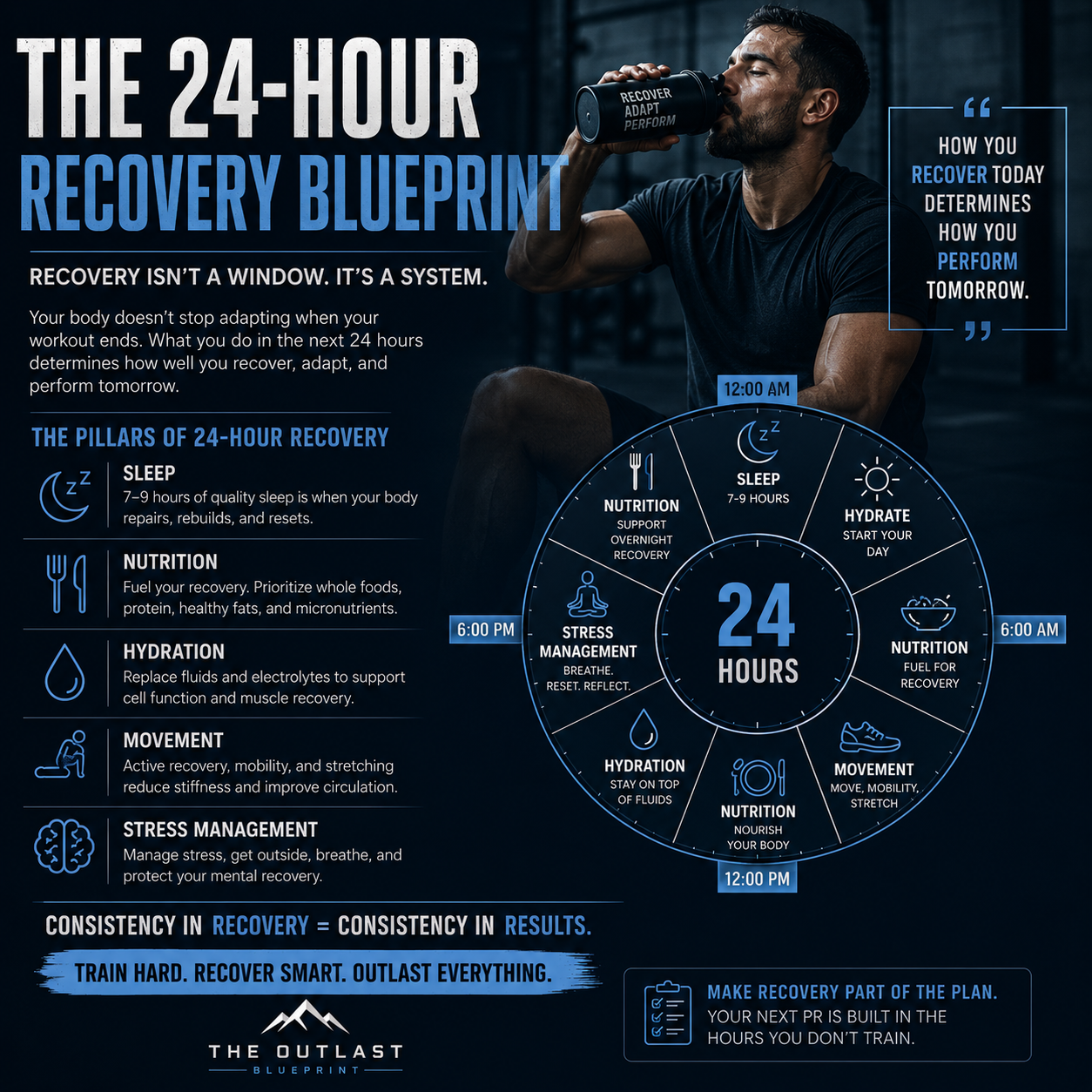
A strong recovery routine does not need to be expensive or complicated. What you do during the first day after a hard workout can shape how you feel, move, and perform in your next session. This 24-hour recovery blueprint focuses on the basics your body depends on: hydration, balanced food, gentle movement, quality sleep, and an honest readiness check.
The 24-hour recovery blueprint below is not about removing every trace of fatigue. Hard training should challenge you. The goal is to support the rebuilding process without turning recovery into another source of stress.
Use these six steps after demanding strength sessions, long endurance workouts, hard practices, or intense competitions.
Step 1: Transition Out of Training Mode
Do not treat the final repetition, sprint, or interval as the exact end of your session.
Spend five to ten minutes lowering your effort. Walk, cycle at an easy pace, or use slow breathing while your heart rate settles. This creates a clear transition between hard work and the rest of your day.
Use that time to notice how your body feels.
Ask yourself:
- Did anything feel sharp, unstable, or unusually restricted?
- Did your movement change as fatigue increased?
- Did one side begin compensating for the other?
- Did the session feel much harder than expected?
You do not need to analyze every sensation. Normal fatigue, muscle tension, and effort are expected after training. The purpose is to notice meaningful changes before they become harder to ignore.
Awareness is not weakness. It is a performance skill. Athletes who recognize early warning signs can make better choices about the next session.

Step 2: Rehydrate Without Overcomplicating It
Sweating reduces body water and can also increase fluid and electrolyte needs. The amount you lose depends on the workout, temperature, humidity, clothing, body size, and your personal sweat rate.
Begin drinking soon after training. Then continue gradually during the day.
You do not need to force a large amount of water at once. The goal is to replace what you lost and return to your normal hydration level.
A simple approach is to:
- Drink with your post-workout meal.
- Keep water available during the next several hours.
- Include electrolytes when the session was long, hot, or very sweaty.
- Use thirst, urine color, and how you feel as practical feedback.
Hydration is only one part of recovery. The American College of Sports Medicine places hydration alongside nutrition, sleep, rest, and active recovery as central parts of the process.
Avoid turning hydration into a contest. More is not always better. Consistent intake across the day is usually easier than trying to catch up all at once.
- Step 3: Eat Enough to Support the Work
Food is not something you earn through exercise. It is part of the system that allows exercise to produce results.
After a demanding workout, aim for a balanced meal that includes:
A meaningful source of protein. Carbohydrates that match your training demands. Fruits or vegetables. Enough total food to support your workload.
Protein provides amino acids that support tissue repair and adaptation. Carbohydrates help restore fuel used during training. Sports nutrition guidance supports meeting both protein and carbohydrate needs during periods of demanding physical activity.
Fruits and vegetables add fiber, fluids, vitamins, minerals, and other useful compounds.
Your meal does not need to be perfect. A practical plate could include chicken, rice, and vegetables. It could also be yogurt, fruit, oats, and nuts.
The best option is one you can prepare, digest, and repeat.
Do not become so focused on a narrow post-workout window that you ignore the rest of the day. One meal matters, but your full eating pattern matters more. Research on nutrient timing suggests that total daily intake remains an important part of the larger recovery picture.
Regularly training hard while eating too little can make it harder to maintain energy, performance, and training quality. Build your nutrition around the work you actually do.
For more context on matching your training to your goal, read our guide to strength versus power.
- Step 4: Keep the Rest of the Day Gently Active
Recovery does not always mean lying still for the rest of the day.
Easy walking and normal daily movement can help you avoid feeling locked up after a hard session. The key is keeping the activity restorative.
Use a simple rule: you should feel the same or better when you finish.
A recovery walk should feel easy. Mobility work should reduce tension, not create more fatigue. Light cycling should stay conversational. Household tasks and normal movement may be enough.
Research on active recovery suggests that brief, low-intensity activity may support some measures of performance recovery. Results vary based on the activity, timing, and type of training completed.
This is where many athletes make a mistake. They turn an easy recovery session into extra conditioning because they feel guilty slowing down.
Control matters. The ability to keep easy work easy is part of long-term performance.
Cold exposure, massage devices, compression, and other tools may feel useful for some people. However, they should sit on top of the fundamentals, not replace them.
Our cold-water recovery guide explains where that tool may fit within a larger routine.

- Step 5: Protect the Most Important Night of Sleep
Sleep is one of the strongest foundations in this 24-hour recovery blueprint.
During sleep, your body supports processes connected to physical restoration, learning, memory, attention, mood, and daily function. Poor sleep can also affect how prepared you feel for another demanding session.
The CDC recommends several practical sleep habits. These include keeping a consistent schedule, making the bedroom quiet and cool, and turning off electronic devices at least 30 minutes before bed.
You do not need a flawless nighttime routine. Start with repeatable actions:
Choose a realistic bedtime. Reduce bright screens and stimulation before bed. Keep the room dark, quiet, and comfortable. Prepare tomorrow’s clothes, food, and training equipment. Avoid treating sleep as leftover time.
Preparation matters because it lowers friction. When your next morning is organized, you are less likely to stay awake thinking about what needs to happen.
Try to protect your full sleep opportunity, not only the final hour before bed. A perfect wind-down routine cannot make up for a bedtime that is consistently too late.
- Step 6: Reassess the Following Morning
The final step of the 24-hour recovery blueprint happens the next morning.
Before automatically following your scheduled workout, take a brief inventory. This does not need to become a long readiness test. Spend one minute checking the signals that matter.
Consider:
- Energy: Do you have normal physical energy?
- Soreness: Is it improving, stable, or getting worse?
- Motivation: Do you feel willing to train?
- Movement: Do basic movements feel normal?
- Stress: How demanding does the day already feel?
- Performance: Have recent sessions met expectations?
One poor score does not mean you need to cancel training.
Sleep can be imperfect. Motivation can fluctuate. Soreness can be present without being a problem.
Look for patterns instead.
If several signals are moving in the wrong direction, adjust before the problem grows. That may mean lowering your volume, reducing intensity, changing the exercises, or using an easier session.
Reducing one workout is often better than forcing poor training for several days.
What This 24-Hour Recovery Blueprint Does Not Require
-
You do not need a room full of devices.
-
You do not need a complicated supplement stack.
-
You do not need to spend hours stretching, rolling, soaking, or tracking every biological signal.
Advanced tools can have a place, but they cannot replace the basics.
A device cannot fix chronic sleep loss. A recovery drink cannot correct weeks of under-eating. A massage cannot undo a training plan that never includes easier days.
Start with the actions that have the greatest reach:
-
Hydrate.
-
Eat enough.
-
Move gently.
-
Sleep.
-
Reassess.
Then add other tools only when they solve a clear problem.
Bottom Line
The best recovery routine is not the one that looks most advanced. It is the one you can follow after normal workouts, busy workdays, travel, and stressful weeks.
Use this 24-hour recovery blueprint as a repeatable checklist.
Transition out of training mode. Restore fluids. Eat a balanced meal. Keep moving without adding more fatigue. Protect your sleep. Reassess before the next session.
Simple actions work when you repeat them.
Recovery then stops being something you attempt only after a setback. It becomes one of the habits that helps you train consistently and stay ready for what comes next.