
KPV does not get nearly as much attention as compounds such as BPC-157 or TB-500, but it may be one of the more interesting research peptides for inflammation.
Instead of focusing primarily on tissue rebuilding, KPV appears to act directly on inflammatory signaling. That distinction may make it particularly interesting for research involving gut inflammation, inflammatory skin conditions, chronic injuries, and other situations where excessive inflammation may interfere with recovery.
There is an important catch: most of the evidence for KPV is still preclinical. Animal and cellular studies are promising, but human clinical evidence remains extremely limited.
GET KPV -> WELCOME20
What Is KPV?
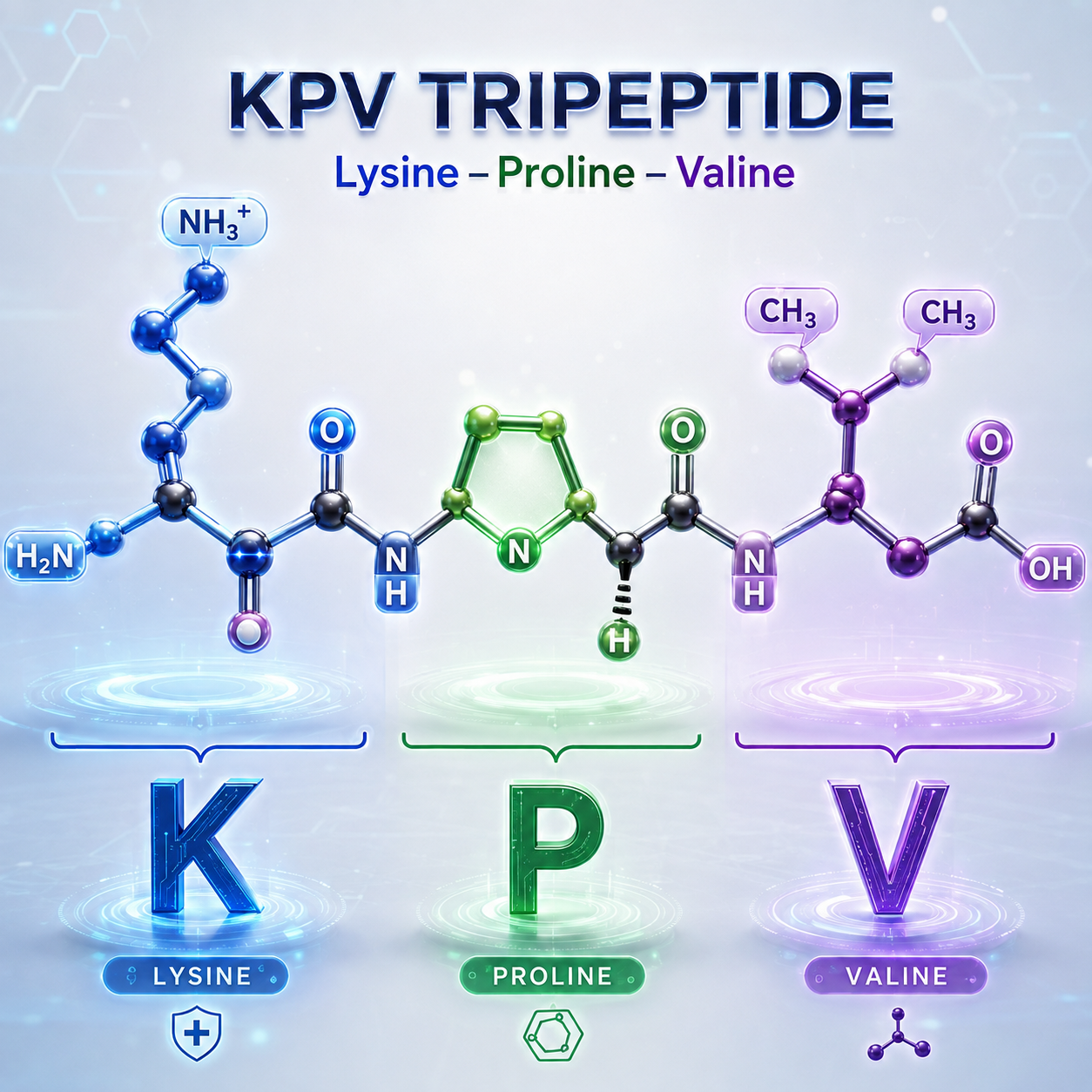
KPV is an extremely small peptide consisting of only three amino acids:
K — Lysine P — Proline V — Valine
Its molecular weight is approximately 342 Da, making it unusually small compared with many commonly discussed peptides. KPV is derived from the C-terminal portion of alpha-melanocyte-stimulating hormone, or α-MSH, a naturally occurring molecule involved in several biological processes, including inflammatory regulation.
Researchers became interested in KPV because this tiny fragment appears to preserve some of the anti-inflammatory activity associated with the larger α-MSH molecule.
Unlike some other compounds derived from the melanocortin system, KPV has been investigated for anti-inflammatory activity without the pigmentary effects associated with melanocortin receptor activation.
That makes KPV particularly interesting because its biological effects appear to be much more focused on inflammation.

How KPV May Reduce Inflammation
One of the most important pathways associated with KPV is NF-κB.
NF-κB is a transcription factor involved in regulating inflammatory genes. When activated, it can increase the production of inflammatory cytokines and other signaling molecules.
In healthy physiology, inflammatory signaling is temporary and controlled. But persistent activation of pathways such as NF-κB is associated with many chronic inflammatory conditions.
Preclinical research has found that KPV can inhibit activation of NF-κB and MAP kinase signaling and reduce the release of inflammatory cytokines.
This makes KPV conceptually different from many compounds discussed primarily for tissue regeneration.
An easy way to think about it is:
Regenerative compounds may help rebuild damaged tissue. KPV may help calm the inflammatory environment surrounding that tissue.
Sometimes both processes may matter.
KPV and PepT1: Why the Gut Is So Interesting
Perhaps the most fascinating KPV research involves the gastrointestinal tract.
KPV can be transported into intestinal cells through a transporter called PepT1.
PepT1 normally helps transport small peptides across intestinal cells. Interestingly, PepT1 expression can increase in the colon during intestinal inflammation.
That creates an unusual possibility.
Inflammation may increase the expression of the very transporter capable of bringing KPV into affected cells.
In experimental studies, KPV uptake through PepT1 reduced inflammatory signaling and inflammatory cytokine production. Oral KPV also reduced disease severity in mouse models of chemically induced colitis.
This is one reason KPV has attracted particular attention in research involving inflammatory bowel disease.
Researchers have even developed nanoparticle delivery systems designed to deliver KPV more selectively to inflamed intestinal tissue. These approaches have produced encouraging results in animal models of ulcerative colitis.
Again, this does not mean KPV has been proven to treat Crohn's disease, ulcerative colitis, or IBS in humans. It means the mechanism is interesting enough to justify further research.
Why KPV Is Different From BPC-157
KPV and BPC-157 are sometimes placed in the same general category because both are discussed around gut health and recovery.
They are not the same thing.
BPC-157 is generally researched around tissue repair, vascular signaling, growth-factor pathways, and healing.
KPV is much more directly associated with inflammatory signaling.
That creates a useful conceptual distinction:
BPC-157 = rebuild
KPV = calm inflammation
This may also explain why combining different mechanisms has become popular in experimental peptide research.
If excessive inflammation is interfering with tissue repair, simply adding more regenerative signaling may not address the entire problem.
Think of a damaged building that is still on fire.
You can bring in construction materials, but rebuilding becomes much easier after controlling the fire.
KPV represents the inflammation side of that equation.
Areas Where KPV Is Being Researched
Gut Inflammation
The strongest scientific case for KPV currently involves gastrointestinal inflammation.
KPV has reduced inflammatory signaling in intestinal epithelial and immune cells and improved disease measures in multiple mouse models of colitis.
Because PepT1 expression increases in inflamed intestinal tissue, oral delivery has received particular research attention.
Potential areas of interest include:
- inflammatory bowel disease
- intestinal barrier dysfunction
- inflammatory components of IBS
- post-infectious intestinal inflammation
- gastrointestinal inflammatory signaling
These remain research applications rather than established clinical indications.
Chronic Injuries
KPV is also discussed experimentally when persistent inflammation appears to be limiting recovery.
This could theoretically include chronic tendinopathies, joint irritation or prolonged inflammatory responses following injury.
The rationale is not that KPV directly reconstructs tendons, cartilage or muscle.
Instead, reducing excessive inflammatory signaling may create a more favorable environment for recovery.
Human evidence demonstrating this effect is currently lacking.
Skin Inflammation
KPV has also been investigated for topical delivery.
Laboratory research has examined methods such as microneedles and iontophoresis to improve KPV penetration through human skin.
This has created interest in inflammatory skin research involving conditions such as eczema, psoriasis, rosacea and acne.
However, evidence supporting clinical treatment of these conditions remains limited.

Autoimmune and Immune-Driven Inflammation
Because NF-κB plays an important role in immune signaling, KPV is sometimes discussed in the context of autoimmune inflammation and mast-cell-related conditions.
This area is much more speculative.
Conditions such as rheumatoid arthritis, MCAS and post-viral inflammatory syndromes should not be considered established indications for KPV. Human clinical trials demonstrating efficacy are currently lacking.
Oral vs. Subcutaneous KPV
The route of administration changes the theoretical purpose.
Oral KPV is particularly interesting for intestinal research because of PepT1-mediated uptake in the gastrointestinal tract. Experimental studies have demonstrated biological activity after oral administration in animal models of colitis.
Subcutaneous KPV is generally discussed for systemic exposure rather than specifically targeting intestinal tissue.
However, there are no established human pharmacokinetic studies defining the absorption, bioavailability, optimal dose or therapeutic exposure of these formulations.
That distinction is important.
A compound being biologically active in animal models does not automatically establish an effective human dose.
Experimental KPV Dosing Ranges
There is currently no FDA-approved or clinically validated human KPV dosing protocol.
Experimental and research-community protocols commonly fall into several broad ranges, but these should not be confused with evidence-based medical dosing.
Low experimental range
Approximately:
250 mcg per day
This is generally discussed as an introductory or lower-exposure range.
Moderate experimental range
Approximately:
500 mcg per day
Oral protocols are sometimes divided into multiple administrations because the intended target is gastrointestinal exposure.
Higher experimental range
Approximately:
1 mg per day
Higher amounts are sometimes discussed around more significant inflammatory states, although there is no human dose-response research establishing that increasing the dose produces greater benefit.
Importantly, the FDA concluded in 2026 that there was insufficient clinical and nonclinical safety information to adequately evaluate KPV and specifically noted the absence of human data.
These numbers should therefore be understood as experimental protocols—not clinical recommendations.
How Long Does KPV Take to Work?
KPV is generally not thought of as an immediately noticeable compound.
Experimental protocols often evaluate changes over several weeks rather than several hours or days.
A practical research timeline may look at:
Weeks 1–2: gastrointestinal symptoms or tolerance
Weeks 2–4: stiffness, soreness, recovery and general inflammatory symptoms
Weeks 4–8: longer-term changes and objective biomarkers
Skin-related changes may take considerably longer.
But there is currently no controlled human trial establishing a reliable KPV response timeline.
Why Researchers Cycle KPV
KPV does not appear to have the same classic receptor-desensitization concern associated with certain receptor agonists.
Cycling is instead largely a conservative strategy.
Because long-term human safety data are lacking, periodically stopping exposure allows researchers to evaluate whether changes persist and limits continuous exposure to an understudied compound.
A commonly discussed experimental structure is approximately:
6–8 weeks of exposure
followed by
2–4 weeks without exposure
Again, this is an experimental convention rather than a clinically validated schedule.
One useful concept behind cycling is the ability to determine whether the underlying problem has actually changed.
If symptoms remain improved after stopping, that may suggest a more durable change.
If they quickly return, the underlying inflammatory driver may still be present.
KPV Stacks: Why Researchers Combine Mechanisms
One of the more interesting aspects of KPV is how differently it functions compared with other research peptides.
KPV + BPC-157
This pairing combines two different theoretical goals:
KPV: reduce inflammatory signaling
BPC-157: support repair pathways
Instead of expecting one compound to accomplish everything, the combination attempts to address both the inflammatory environment and tissue repair.
KPV + BPC-157 + TB-500
TB-500 is frequently added when research focuses on tissue remodeling, migration and recovery.
Conceptually:
KPV → inflammation
BPC-157 → repair
TB-500 → remodeling
Evidence demonstrating that this combination improves human outcomes is not available.
KPV + Larazotide
Larazotide has been studied around intestinal tight-junction regulation.
The theoretical pairing is interesting because the compounds address two different aspects of intestinal barrier dysfunction:
Larazotide → tight-junction regulation
KPV → inflammatory signaling
KPV + LL-37
LL-37 is an antimicrobial peptide involved in innate immunity.
Combining an antimicrobial compound with an anti-inflammatory compound is sometimes discussed when intestinal microbial imbalance and inflammation coexist.
This remains highly experimental.
KPV + Thymosin Alpha-1
Thymosin alpha-1 is studied primarily for immune modulation.
Pairing it with KPV theoretically combines immune regulation with direct anti-inflammatory activity.
Once again, clinical evidence for the combination is lacking.
What Should Be Tracked?
One of the biggest mistakes in self-experimentation is relying only on whether someone "feels different."
If KPV is being investigated around inflammation, tracking should ideally include both subjective and objective measures.
Subjective measures may include:
- morning stiffness
- pain
- gastrointestinal discomfort
- bloating
- stool quality
- post-meal symptoms
- energy
- sleep quality
- skin symptoms
- recovery between training sessions
Objective measures may include inflammatory biomarkers such as high-sensitivity C-reactive protein (hs-CRP) alongside appropriate laboratory testing selected by a medical professional.
These measures are far more informative when collected before and after an intervention rather than relying on memory.
What KPV Cannot Fix
KPV should not be treated like an inflammation eraser.
If the underlying cause of inflammation remains unchanged, reducing inflammatory signaling alone may not solve the problem.
For example, persistent injury caused by repetitive mechanical overload will continue producing irritation.
Likewise, gastrointestinal symptoms caused by diet, infection, medication, stress or another underlying disease require the actual cause to be addressed.
Sleep, nutrition, stress management, physical rehabilitation and appropriate medical treatment still matter.
KPV should be thought of as one potential experimental tool—not a substitute for identifying the underlying problem.
Safety and Evidence Limitations
This may be the most important section of the entire discussion.
KPV has interesting mechanisms and encouraging preclinical research, particularly involving intestinal inflammation.
But preclinical evidence is not the same as demonstrated human efficacy or safety.
In its July 2026 evaluation, the FDA reported that it found no published studies involving KPV drug products used in humans. The agency also stated that there was insufficient information to evaluate effectiveness for wound healing and inflammatory conditions and insufficient clinical and nonclinical information to determine human safety.
The FDA ultimately concluded that the available evidence weighed against adding KPV free base or KPV acetate to the 503A Bulks List.
Pregnancy and pediatric use are particularly difficult to justify because adequate safety data do not exist.
Any severe allergic reaction, neurological symptoms, worsening inflammatory or autoimmune symptoms, significant injection-site reaction or persistent gastrointestinal problem warrants medical evaluation rather than simply adjusting an experimental protocol.
Why KPV Still Deserves Attention
The lack of human research does not make KPV scientifically uninteresting.
Quite the opposite.
KPV has several characteristics that make it worthy of continued investigation:
It is extremely small.
It is derived from a naturally occurring anti-inflammatory signaling molecule.
It can interact with intestinal peptide transport systems.
It has repeatedly demonstrated anti-inflammatory activity in experimental models.
And researchers continue developing new methods of delivering it selectively to inflamed tissue.
The missing piece is human research.
Until well-controlled clinical trials are performed, the gap between an exciting biological mechanism and an effective therapy remains significant.
Conclusion: KPV May Be More About Calming Than Rebuilding
KPV is interesting because it approaches recovery from a different direction.
BPC-157 and TB-500 are typically discussed around repair and remodeling.
KPV is primarily interesting because of inflammation.
Its ability to reduce inflammatory signaling and its unusual relationship with PepT1 in inflamed intestinal tissue make it particularly compelling for gut-focused research.
That may also explain why it could theoretically complement regenerative compounds rather than compete with them.
The simplest way to understand KPV is this:
Before rebuilding damaged tissue, sometimes you first need to calm the environment surrounding it.
That is where KPV could ultimately prove most valuable.
For now, however, KPV remains an experimental compound with promising preclinical science and a major lack of controlled human data. That distinction should remain at the center of any serious discussion about its potential.