
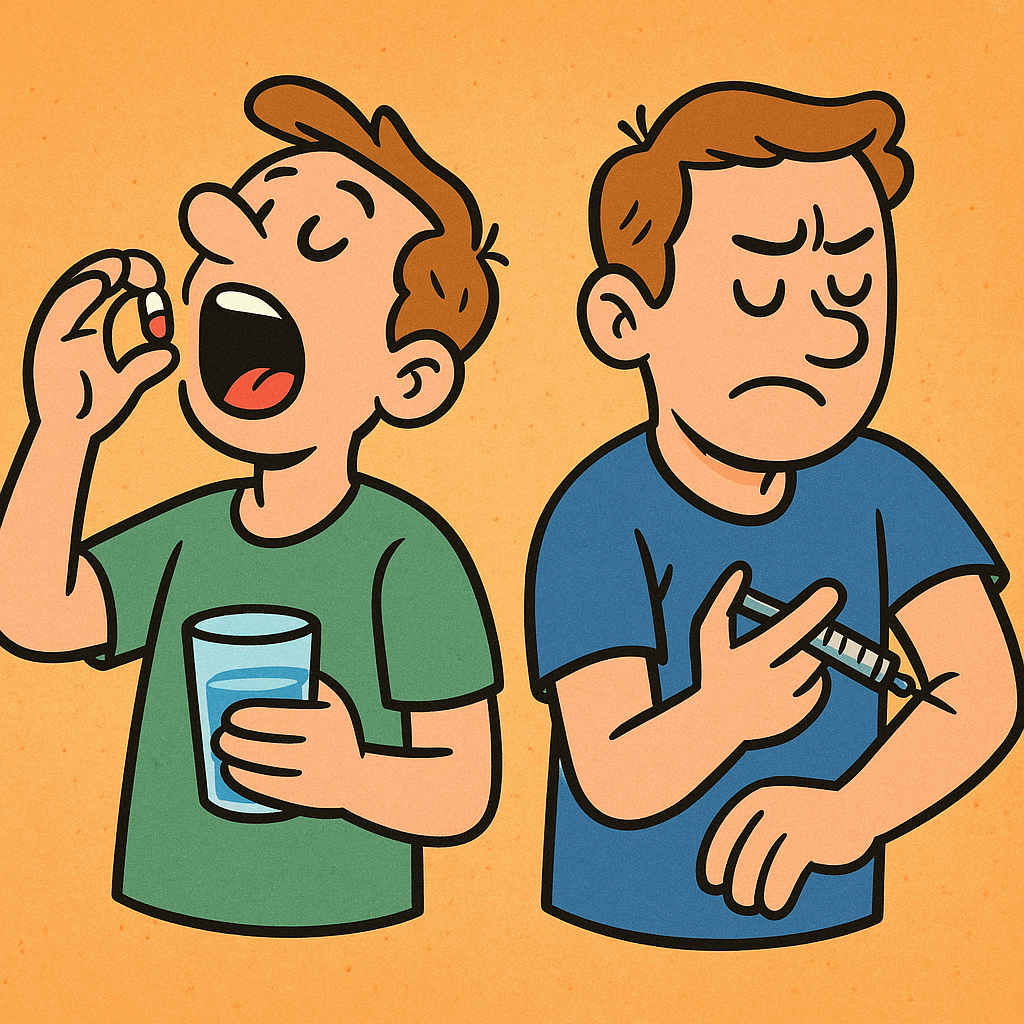
A 1 mg dose does not necessarily mean your body receives 1 mg.
That distinction is one of the most important—and most overlooked—concepts in pharmacology.
A compound can be swallowed, injected, sprayed into the nose, placed under the tongue, or applied to the skin. The amount administered may be identical, yet the amount that actually reaches circulation can be dramatically different.
That difference is called bioavailability.
Understanding bioavailability becomes especially important with peptides, because many peptides are relatively large molecules that can be degraded or poorly absorbed depending on how they enter the body.
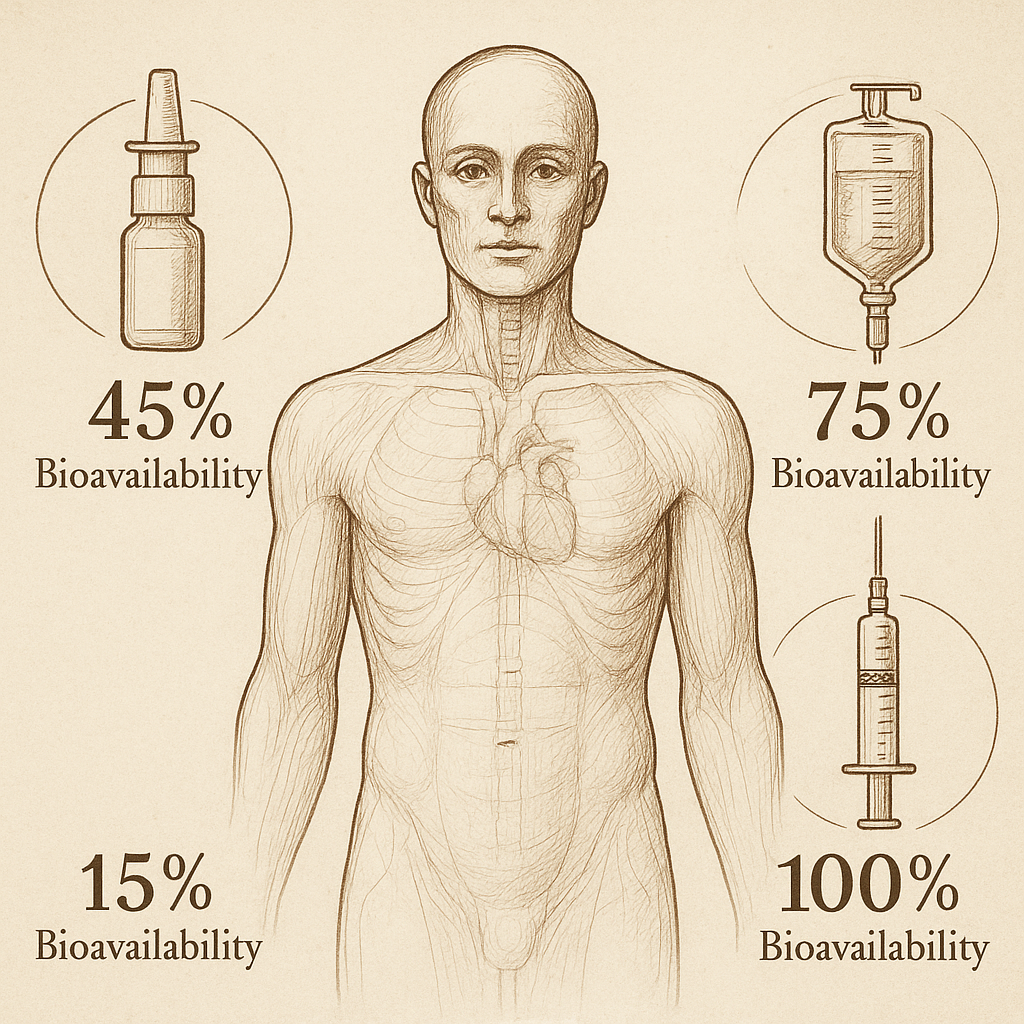
What Is Bioavailability?
Bioavailability describes the rate and extent to which an active compound is absorbed and becomes available at its site of action.
The FDA uses bioavailability studies to determine how much of a drug becomes available after administration and how quickly that exposure occurs.
Bioavailability is commonly represented as a percentage.
For example:
100% bioavailability means essentially the entire administered dose enters systemic circulation.
20% bioavailability means approximately one-fifth of the administered dose reaches systemic circulation intact.
5% bioavailability means only about one-twentieth reaches circulation.
This means two identical doses given through different routes can produce very different systemic exposure.
If a hypothetical peptide has:
- 90% bioavailability by one route
- 20% bioavailability by another route
then a 1 mg dose does not create the same exposure through both methods.
This is why the dose printed on a vial or nasal spray tells only part of the story.
Why Bioavailability Matters
Bioavailability influences how much of a compound actually has the opportunity to produce a biological effect.
Researchers frequently measure pharmacokinetic markers such as AUC, Cmax, and Tmax when evaluating bioavailability.
AUC represents overall exposure over time.
Cmax is the highest measured concentration in the blood.
Tmax describes how long it takes to reach that maximum concentration.
The FDA specifically uses systemic concentration-over-time measurements when evaluating drug bioavailability.
This becomes particularly important when comparing different delivery methods.
A compound might technically be absorbed through two different routes while producing dramatically different concentrations.
So asking:
“Can this peptide be absorbed intranasally?”
is only the first question.
The more useful question is:
“How much is absorbed intranasally compared with another route?”
That is where pharmacokinetic data become valuable.
Injection and the “100% Bioavailability” Idea
You will often hear people say:
“Injection has 100% bioavailability.”
That statement needs one important qualification.
Intravenous injection is considered 100% bioavailable.
An IV dose is placed directly into systemic circulation, so there is no absorption barrier to overcome. This is why intravenous administration is commonly used as the reference when researchers calculate absolute bioavailability for another route.
Subcutaneous and intramuscular injections are different.
A subcutaneous peptide still has to move through tissue and enter blood vessels or lymphatic circulation before reaching systemic circulation. Peptides can also undergo degradation at the injection site before they are completely absorbed.
Studies of therapeutic proteins have found that subcutaneous bioavailability can be incomplete and variable. Injection location can even influence the pharmacokinetics of some peptides and small proteins.
Anecdotal Note: Why Injections Often Feel More Predictable
In peptide communities, people frequently describe injections as producing more predictable or consistent effects than nasal administration.
There is a reasonable pharmacological explanation for why that perception might occur.
Subcutaneous administration bypasses many of the barriers encountered by oral or intranasal delivery. There is no need for the compound to cross the nasal epithelium or survive the gastrointestinal tract.
However, an anecdotal report such as “I feel injections more” is not the same thing as a pharmacokinetic study.
Subjective effects cannot tell us precisely what percentage of a peptide was absorbed.
Intranasal Bioavailability Is Much More Variable
The nose is an interesting drug-delivery system.
The nasal cavity contains a highly vascularized mucosal surface capable of absorbing drugs into systemic circulation. Intranasal administration is also being investigated as a potential route for delivering certain compounds toward the central nervous system.
But nasal bioavailability is far from universal.
It can depend on:
- Molecular size
- Molecular charge
- Lipophilicity
- Peptide stability
- Enzymatic degradation
- Nasal mucus
- Mucociliary clearance
- Formulation
- Concentration
- Spray volume
- Delivery device
- Where inside the nasal cavity the compound is deposited
Reviews of nasal drug delivery emphasize that absorption can vary considerably depending on the compound, formulation, species studied, and delivery system.
The nose also actively clears foreign material. Mucociliary clearance moves mucus toward the nasopharynx, limiting how long a drug may remain against the absorptive surface.
For peptides, molecular size becomes another important issue. Published reviews have identified successful experimental intranasal delivery of peptides with molecular weights reaching approximately 6,000 Da, but successful delivery does not mean every peptide below that molecular weight will have good bioavailability.
Nasal Peptides Can Have Very Different Bioavailability
Actual pharmacokinetic studies illustrate just how large the difference can be.
Researchers studying GHRH(1-29) reported only approximately 3–5% intranasal bioavailability.
In another pharmacokinetic study, ipamorelin showed approximately 20% intranasal bioavailability.
Experimental research with GHRP-6 reported estimated intranasal bioavailability around 34–45% under the conditions studied.
Those examples demonstrate why it is misleading to assign a single number to “nasal peptide absorption.”
Intranasal bioavailability is a characteristic of the specific molecule + formulation + delivery system, not simply the fact that something was sprayed into the nose.
Anecdotal Note: Nasal Sprays Are Not Automatically Equivalent to Injections
This distinction gets lost frequently in discussions about research peptides.
Someone may take:
500 mcg by injection
and compare it with:
500 mcg intranasally
as though those represent equivalent exposures.
They may not.
If the hypothetical nasal bioavailability were 20%, systemic exposure from that route could be dramatically lower.
At the same time, systemic bioavailability is not necessarily the only goal of intranasal administration. Some research investigates nose-to-brain transport, where the objective is CNS delivery rather than maximizing concentrations in peripheral blood.
That makes nasal pharmacology even more complicated.
| Peptide | Intranasal evidence | Strength |
|---|---|---|
| Semaglutide | ⚠️ Tested, but poor/unsuccessful brain delivery | Weak/negative |
| Tirzepatide | ❌ No direct evidence found | — |
| Retatrutide | ❌ No direct evidence found | — |
| BPC-157 | ❌ No convincing absorption data found | — |
| TB-500 / Tβ4 | ❌ No convincing nasal absorption data found | — |
| GHK-Cu | ✅ Intranasal effects in mice | Preclinical |
| CJC-1295 | ❌ No direct evidence found | — |
| Ipamorelin | ✅ ~20% nasal bioavailability | PK evidence |
| Sermorelin / GHRH(1-29) | ✅ ~3–5% nasal bioavailability | Human PK |
| Tesamorelin | ❌ No direct evidence found | — |
| AOD-9604 | ❌ No direct evidence found | — |
| MOTS-c | ❌ No direct evidence found | — |
| SS-31 / Elamipretide | ❌ No direct evidence found | — |
| Epitalon | ✅ Intranasal CNS effects | Preclinical |
| Thymosin Alpha-1 | ❌ No direct evidence found | — |
| KPV | ❌ No direct evidence found | — |
| LL-37 | ⚠️ Intranasal/local airway activity, but not clear systemic/CNS absorption | Local evidence |
| Semax | ✅ Extensive intranasal animal + human data | Strong functional evidence |
| Selank | ✅ Intranasal brain PK/distribution + functional studies | Direct PK evidence |
| Dihexa | ❌ No direct evidence found | — |
| DSIP | ✅ Human intranasal studies | Human functional |
| Kisspeptin-10 | ✅ Intranasal animal data | Preclinical |
| PT-141 / Bremelanotide | ✅ Human intranasal PK + clinical studies | Strong human evidence |
| Melanotan II | ⚠️ Intranasal administration studied, but evidence does not convincingly establish useful absorption | Weak |
| HGH Fragment 176-191 | ❌ No direct evidence found | — |
| IGF-1 LR3 | ❌ No direct evidence found | — |
| PEG-MGF | ❌ No direct evidence found | — |
| GHRP-2 | ✅ Human intranasal effects/systemic exposure | Human evidence |
| GHRP-6 | ✅ ~34–45% nasal bioavailability | Strong PK evidence |
| Setmelanotide | ❌ No direct evidence found | — |
Trusted research provider -> WELCOME20
Bioavailability Is Not the Same as Effectiveness
Another common mistake is assuming higher bioavailability automatically means a better treatment.
It does not.
Bioavailability tells us about exposure.
Effectiveness tells us what that exposure actually does.
A compound with 20% bioavailability could still produce a meaningful biological response if only a small amount is required.
Meanwhile, a compound with high bioavailability could still fail to produce the desired outcome.
Pharmacokinetics tells us what the body does to the compound.
Pharmacodynamics tells us what the compound does to the body.
Both matter.
Why Peptides Make Bioavailability Especially Important
Peptides present unusual delivery challenges because they sit between traditional small-molecule drugs and much larger proteins.
Many peptides are hydrophilic, relatively large, and susceptible to enzymatic degradation.
This is one reason oral peptide delivery has historically been difficult. Most peptides have extremely poor oral bioavailability because they encounter stomach acid, digestive enzymes, intestinal barriers, and other obstacles before reaching circulation.
Injection largely bypasses those gastrointestinal barriers.
Intranasal administration attempts to bypass them as well—but introduces an entirely different set of absorption barriers.
That is why route of administration matters so much when interpreting peptide research.
What to Look for When Researching Bioavailability
When evaluating a peptide or other compound, do not stop at claims that it “works intranasally” or “can be absorbed.”
Look for actual pharmacokinetic research.
Useful information includes:
Absolute bioavailability: How much reaches circulation compared with IV administration?
AUC: What is the total systemic exposure?
Cmax: What peak concentration occurs?
Tmax: How quickly does that concentration occur?
Human vs. animal research: Rat nasal absorption does not automatically predict human nasal absorption.
Formulation: Was the peptide administered alone or with an absorption enhancer?
Delivery device: Where the formulation is deposited inside the nose can matter.
Route: Was the study measuring systemic absorption, local nasal activity, or direct nose-to-brain delivery?
These details can turn a seemingly simple question about dosage into a much more meaningful discussion about actual exposure.
Conclusion
Bioavailability answers one deceptively simple question:
How much of the administered compound actually becomes available to the body?
Intravenous administration provides the reference point at essentially 100% systemic bioavailability because the compound is delivered directly into circulation. Subcutaneous injections generally provide efficient delivery, but they should not automatically be described as 100% bioavailable.
Intranasal delivery is much more variable.
Some peptides demonstrate meaningful nasal absorption. Others show very little. Molecular size, formulation, enzymatic stability, nasal clearance, and delivery technique can all influence the result.
That is why the dose alone does not tell you the true exposure.
When comparing peptide delivery routes, the better question is not simply:
“How many milligrams were administered?”
It is:
“How many milligrams actually became bioavailable?”
Sources
-
U.S. Food and Drug Administration. Bioavailability Studies Submitted in NDAs or INDs — General Considerations.
-
Keller LA, et al. Intranasal drug delivery: opportunities and toxicologic challenges during drug development.
-
Al Bakri W, et al. Overview of intranasally delivered peptides.
-
Zou P, et al. Impact of injection sites on clinical pharmacokinetics of subcutaneously administered peptides and proteins.
-
Esposito S, et al. Subcutaneous catabolism of peptide therapeutics: bioanalytical approaches and ADME considerations.
-
Johansen PB, et al. Pharmacokinetic evaluation of ipamorelin and other peptidyl growth hormone secretagogues. PMID: 9879640.
-
Nelson AH, et al. Intranasal activity of the growth hormone releasing peptide GHRP-6. PMID: 2046459.
-
Wilton P, et al. Study of intranasal GHRH(1-29)-NH2 absorption and growth-hormone secretion. PMID: 8329825.