

GHK-Cu may feel like a new arrival in the longevity and recovery world, but the molecule has been studied for more than 50 years.
Its story started in 1973, long before peptides became popular in skincare clinics, recovery protocols, or social media. Researchers were originally trying to understand why blood from younger people seemed to affect the behavior of older human liver tissue. What they isolated was a tiny three-amino-acid molecule that would eventually become known as GHK.
Researchers later discovered that GHK binds strongly to copper, creating GHK-Cu, or glycyl-L-histidyl-L-lysine copper.
What followed was decades of research into collagen synthesis, wound healing, tissue remodeling, inflammation, oxidative stress, skin aging, and hair follicles.
The science is intriguing.
Get GHK-Cu -> WELCOME20

GHK-Cu Was Discovered More Than 50 Years Ago
The history of GHK-Cu begins with biochemist Loren Pickart and researcher M. Michael Thaler.
In 1973, Pickart and Thaler published a paper in Nature New Biology describing a small molecule isolated from human serum that increased the survival of normal liver cells in culture.
The paper was titled “Tripeptide in Human Serum Which Prolongs Survival of Normal Liver Cells and Stimulates Growth in Neoplastic Liver.”
At that point, researchers knew they had found an unusual biological signal, but its exact identity was still being worked out.
Four years later, in 1977, Pickart, Thaler, and David Schlesinger reported that the growth-modulating molecule was the three-amino-acid sequence:
Glycine – Histidine – Lysine
Or simply:
GHK
Then came another major piece of the puzzle.
In 1980, Pickart and colleagues reported in Nature that GHK readily forms complexes with copper and appeared capable of increasing copper uptake into cultured cells.
That work helped establish the biological importance of the copper-bound form now known as GHK-Cu.
The early history looks roughly like this:
1973 → Biological activity discovered in human serum
1977 → Molecule identified as Gly-His-Lys, or GHK
1980 → Copper binding and copper transport investigated
1980s onward → Research expands into collagen, tissue repair, wound healing, and skin biology
That makes GHK one of the older compounds currently attracting attention in the modern peptide space.
What Exactly Is GHK-Cu?
GHK is an extremely small tripeptide made from only three amino acids:
Glycine Histidine Lysine
GHK has a strong affinity for copper ions. When GHK binds copper, it forms the complex known as GHK-Cu.
Research suggests this complex can interact with biological pathways involved in tissue remodeling and repair.
The copper component is important.
Copper is required for several biological processes involved in connective tissue and cellular function. It also serves as a cofactor for enzymes involved in collagen formation, antioxidant defense, and tissue repair.
Instead of thinking of GHK-Cu as simply “copper supplementation,” it may be more useful to think of GHK as a copper-binding biological signaling molecule that influences how copper interacts with tissues.
This may help explain why GHK-Cu has been studied across seemingly unrelated areas such as skin aging, wound repair, inflammation, and extracellular-matrix remodeling.
GHK-Cu and Collagen Production
One of the strongest reasons GHK-Cu gained attention is its relationship with collagen.
In a 1988 study published in FEBS Letters, researchers exposed fibroblast cultures to GHK-Cu and found increased collagen synthesis.
Fibroblasts are cells responsible for producing many of the structural components of connective tissue, including collagen.
Researchers later found additional effects on the extracellular matrix.
A 1992 study found that GHK-Cu increased production of certain glycosaminoglycans, molecules that form part of the structural environment surrounding cells.
Interestingly, the response appeared to be dose-dependent and strongest within a specific concentration range rather than simply increasing indefinitely as concentrations increased.
GHK-Cu has also been shown to influence matrix metalloproteinases and other pathways involved in breaking down and rebuilding extracellular tissue.
That distinction matters.
Healthy tissue repair is not simply about producing as much collagen as possible. Old or damaged matrix also has to be broken down, reorganized, and replaced.
This combination of production and remodeling is one reason researchers have continued investigating GHK-Cu for skin and wound repair.
Why GHK-Cu Became Popular for Skin
Today, GHK-Cu is probably best known as a skincare ingredient, often appearing on labels as copper tripeptide-1.
Its popularity makes biological sense.
Collagen loss and changes in extracellular-matrix structure are major features of aging skin, and GHK-Cu has repeatedly demonstrated effects on fibroblasts and matrix remodeling in experimental research.
A major 2018 review examined decades of GHK-Cu research and described reported effects involving collagen synthesis, tissue remodeling, antioxidant activity, inflammatory signaling, and wound repair.
However, there is an important distinction between biological mechanisms and visible anti-aging outcomes in people.
Human clinical evidence exists, but it is not nearly as extensive as the amount of laboratory evidence.
One randomized controlled study involving patients undergoing CO2 laser resurfacing compared postoperative skincare with and without GHK-Cu.
Researchers found no significant objective difference in wrinkles, overall skin quality, or resolution of redness between the two groups.
Patients using the GHK-Cu products did report greater satisfaction with their overall skin quality, but only 13 patients completed the trial.
That makes it a very small study.
More recent reviews of topical GHK-Cu have reached a similar conclusion: the laboratory evidence is promising, but important limitations remain around skin penetration, formulation, dosing, and the amount of high-quality human clinical research.
The evidence can be summarized more accurately as:
Strong biological rationale + extensive preclinical evidence + limited clinical evidence
That is more compelling than having no evidence at all, but it is not the same as having a large collection of randomized human trials.
Get GHK-Cu -> WELCOME20
GHK-Cu and Wound Healing
Wound repair is another major area of GHK-Cu research.
Studies have reported effects on:
-
Collagen production
-
Fibroblast activity
-
Extracellular-matrix remodeling
-
Blood-vessel formation
-
Inflammatory signaling
All of these processes play important roles during normal wound healing.
Importantly, there is at least some human evidence.
A clinical study involving patients with diabetic neuropathic ulcers evaluated a GHK-copper treatment and reported improved healing compared with conventional therapy.
This study is frequently cited as one of the more important pieces of human wound-healing evidence involving GHK-Cu.
However, a much larger portion of the wound-healing literature comes from cell cultures and animal models rather than large modern randomized human trials.
Reviews of the research describe improvements in wound contraction, collagen formation, angiogenesis, and inflammatory markers across several experimental models.
The biological evidence is impressive, but the clinical evidence remains less developed.
Does GHK-Cu Affect Inflammation and Oxidative Stress?
GHK-Cu appears to influence pathways beyond collagen.
Research reviews describe both anti-inflammatory and antioxidant activity.
These effects may involve changes in inflammatory cytokines, oxidative-stress pathways, and genes associated with tissue repair.
One particularly interesting area involves gene expression.
Researchers analyzing gene-expression databases have reported that GHK may influence expression patterns across a surprisingly large number of genes.
Many of those genes are involved in processes such as:
-
Tissue repair
-
Inflammation
-
Cellular stress responses
-
Extracellular-matrix regulation
-
Antioxidant activity
-
Cellular communication
This has contributed to some of the excitement around GHK-Cu in longevity research.
However, gene-expression findings need to be interpreted carefully.
Changing the expression of a gene does not automatically mean a compound has been clinically proven to reverse aging, regenerate organs, or extend lifespan.
Gene-expression research helps researchers identify possible mechanisms.
It is several steps removed from proving a meaningful clinical outcome in humans.
This is one area where some online claims about GHK-Cu have moved considerably faster than the evidence.
What About GHK-Cu for Hair Growth?
GHK-Cu is also commonly discussed for hair growth, but this area requires another important distinction.
Some frequently cited hair research actually involves AHK-Cu, a related copper-binding tripeptide, rather than GHK-Cu itself.
A 2007 study found that AHK-Cu stimulated elongation of human hair follicles grown outside the body and increased proliferation of cultured dermal papilla cells.
Dermal papilla cells play an important role in regulating the hair-growth cycle.
Earlier animal research has also reported hair-follicle stimulation from peptide-copper complexes.
These findings make copper peptides interesting candidates for hair research.
However, they should not be interpreted as proof that topical or injectable GHK-Cu is equivalent to established treatments for hair loss.
The Rite Aid GHK-Cu resource similarly describes GHK-Cu as potentially supporting the follicle environment rather than functioning as a hormonal hair-loss treatment.
There is biological rationale here, but much more high-quality human research is still needed.
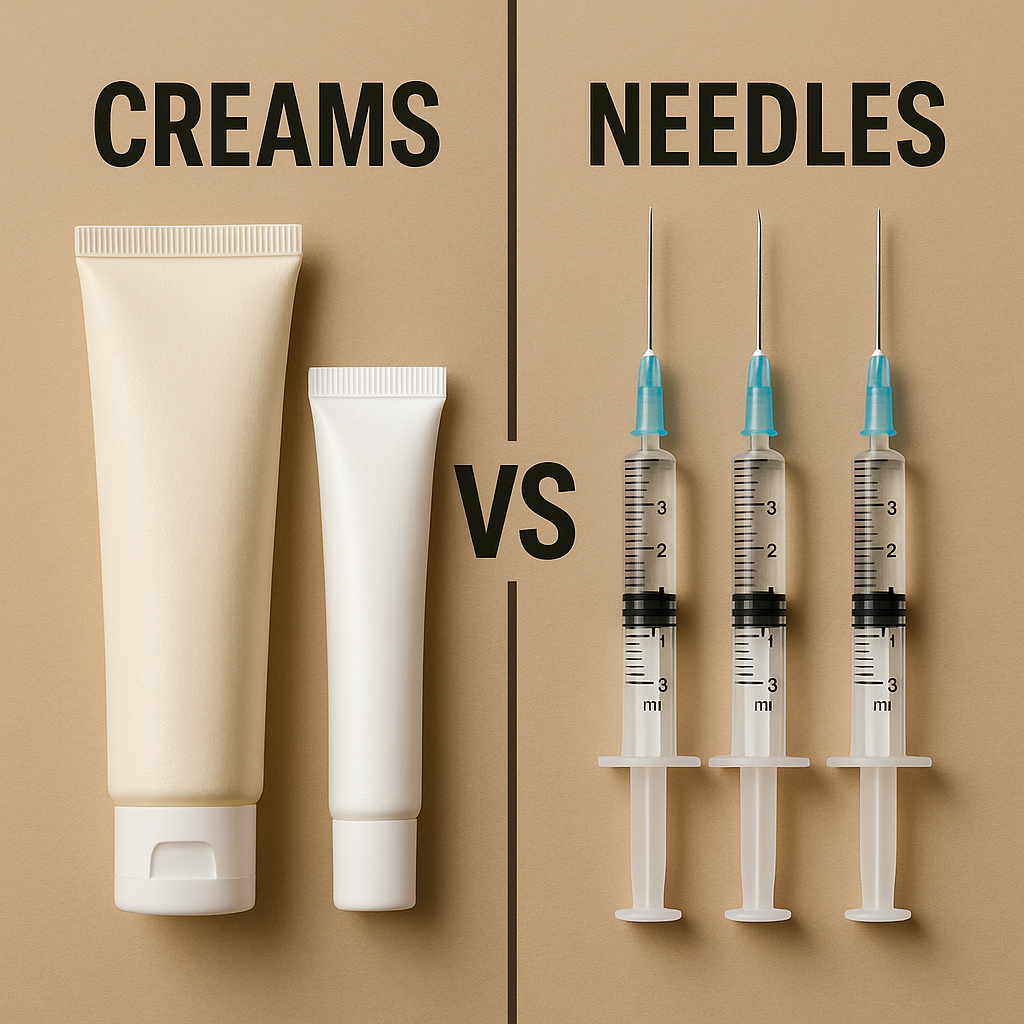
Topical GHK-Cu vs Injectable GHK-Cu
This may be the most important distinction for anyone researching GHK-Cu.
Topical GHK-Cu and injectable GHK-Cu should not be treated as interchangeable interventions.
Topical copper peptides have been incorporated into cosmetic products for years and are primarily intended to produce local effects in the skin.
Injectable GHK-Cu introduces the compound into the body through a completely different route.
That raises different questions involving:
-
Sterility
-
Impurities
-
Immune reactions
-
Peptide aggregation
-
Systemic exposure
-
Pharmacokinetics
-
Long-term safety
There is currently no standardized FDA-approved injectable GHK-Cu treatment regimen. Most of them are sourced trhoug the "Gray Market"
The FDA has specifically stated that compounded injectable products containing GHK-Cu may present an immunogenicity risk related to aggregation and peptide-related impurities.
The agency also states that available human safety information for injectable GHK-Cu is limited.
This is an important limitation when comparing injectable protocols promoted online with the actual clinical evidence.
Why GHK-Cu Is Still So Interesting
Get GHK-Cu -> WELCOME20
GHK-Cu stands out because its popularity did not begin with the modern peptide boom.
Researchers have been studying some aspect of the molecule since 1973.
Across those decades, research has repeatedly pointed toward several interconnected biological effects.
GHK-Cu appears to influence:
-
Collagen synthesis
-
Extracellular-matrix production
-
Tissue remodeling
-
Wound-repair pathways
-
Inflammatory signaling
-
Oxidative-stress pathways
-
Copper transport and cellular copper biology
That gives GHK-Cu considerably more mechanistic history than many compounds currently discussed in the longevity space.
But there is also a recurring problem.
Much of the excitement surrounding GHK-Cu comes from cell studies, animal models, and mechanistic research.
The number of large, well-controlled modern human trials remains relatively small.
In other words, the molecule may be genuinely interesting without every claim surrounding it being established.
Get GHK-Cu -> WELCOME20
GHK-Cu Dosing Protocol
Subcutaneous GHK-Cu protocol gradually increases the dose over a 12-week period.
The protocol uses GHK-Cu five days per week with two days off.
Weeks 1–4
-
Dose: 1 mg once daily
-
Frequency: 5 days per week
-
Schedule: 5 days on, followed by 2 days off
This initial phase uses the lowest dose in the protocol before gradually increasing exposure.
Weeks 5–8
-
Dose: 1.5 mg once daily
-
Frequency: 5 days per week
-
Schedule: 5 days on, followed by 2 days off
The dose increases by 0.5 mg after the first four weeks.
Weeks 9–12
-
Dose: 2 mg once daily
-
Frequency: 5 days per week
-
Schedule: 5 days on, followed by 2 days off
The complete progression is:
-
Weeks 1–4 → 1 mg daily
-
Weeks 5–8 → 1.5 mg daily
-
Weeks 9–12 → 2 mg daily
5 days on / 2 days off
Total protocol length → 8–12 weeks
This as an educational protocol rather than an established medical treatment regimen. Injectable GHK-Cu does not currently have an FDA-approved dosing schedule.
Should Zinc Be Supplemented With GHK-Cu?
Because GHK-Cu contains copper, zinc is sometimes discussed alongside GHK-Cu protocols. Zinc and copper have an important nutritional relationship, but this does not mean everyone using GHK-Cu automatically needs a zinc supplement.
In fact, there is currently no established clinical guideline showing that zinc needs to be started at a particular point during a GHK-Cu cycle.
For most people, the goal should be to maintain an adequate normal zinc intake rather than automatically adding a high-dose zinc supplement.
The Recommended Dietary Allowance for zinc in adults is:
-
Men: 11 mg per day
-
Women: 8 mg per day
These amounts include zinc obtained from both food and supplements.
Good dietary sources include meat, seafood, eggs, dairy products, beans, nuts, and seeds.
When Does Zinc Supplementation Make More Sense?
Zinc supplementation may be worth considering when dietary intake is inadequate, laboratory testing suggests zinc deficiency, or a healthcare professional has identified an increased need for zinc.
It should not automatically be added simply because someone is using GHK-Cu.
This distinction is important because zinc and copper compete biologically.
High doses of supplemental zinc can interfere with copper absorption. The NIH reports that zinc intakes around 60 mg per day for several weeks can reduce markers of copper status, while doses of 50 mg or more taken for weeks can inhibit copper absorption.
The tolerable upper intake level for zinc in adults is 40 mg per day from food and supplements unless higher doses are being used under medical supervision.
Because GHK-Cu is itself a copper-containing compound, routinely taking large amounts of zinc in an attempt to “balance” the copper is not supported by clinical evidence.
During the GHK-Cu Protocol
There is no evidence-based requirement to take additional zinc simply because GHK-Cu is being used.
Maintaining normal dietary zinc intake is reasonable.
Someone who already takes a multivitamin or zinc supplement should also check the amount of elemental zinc they are consuming rather than automatically adding another zinc product.
It is also worthy checking your blood work BEFORE and AFTER GHK-Cu. You can use your blood work before GHK-Cu as your baseline and compare it with your numbers at the end of the protocol and consider supplementation then.
In other words:
GHK-Cu does not automatically require zinc supplementation.
Adequate zinc intake should be maintained throughout the protocol.
High-dose zinc should not be used simply to counterbalance GHK-Cu.
Supplemental zinc makes the most sense when dietary intake is inadequate, zinc deficiency is suspected or confirmed, or it has been recommended based on an individual's nutritional status.
This is particularly important because excessive zinc can create the opposite problem by lowering copper status.
The content of this blog is for educational purposes only. Please discuss with your medical personnel before taking any action.
Sources
National Institutes of Health Office of Dietary Supplements. Zinc: Fact Sheet for Health Professionals. https://ods.od.nih.gov/factsheets/Zinc-HealthProfessional/
National Institutes of Health Office of Dietary Supplements. Copper: Fact Sheet for Health Professionals. https://ods.od.nih.gov/factsheets/Copper-HealthProfessional/
U.S. Food and Drug Administration. Certain Bulk Drug Substances for Use in Compounding May Present Significant Safety Risks. https://www.fda.gov/drugs/human-drug-compounding/certain-bulk-drug-substances-use-compounding-may-present-significant-safety-risks
Conclusion
GHK-Cu is not a new discovery.
It is a molecule with more than five decades of scientific history.
GHK was first reported in human serum in 1973, identified as the three-amino-acid sequence glycine-histidine-lysine in 1977, and connected to copper binding and cellular copper transport by 1980.
Since then, researchers have produced substantial evidence showing that GHK-Cu can influence collagen synthesis, extracellular-matrix remodeling, wound repair, inflammatory pathways, and oxidative stress.
The strongest case for GHK-Cu today is therefore not that it is a miracle anti-aging compound.
It is that multiple decades of biological research point toward a genuine role in tissue repair and remodeling that deserves continued human study.
More than 50 years after its discovery, researchers are still trying to determine just how much of GHK-Cu’s remarkable laboratory biology translates into meaningful benefits in humans.
Sources
-
Pickart L, Thaler MM. Tripeptide in Human Serum Which Prolongs Survival of Normal Liver Cells and Stimulates Growth in Neoplastic Liver. Nature New Biology. 1973;243:85–87. https://pubmed.ncbi.nlm.nih.gov/4349963/
-
Schlesinger DH, Pickart L, Thaler MM. Growth-modulating serum tripeptide is glycyl-histidyl-lysine. Experientia. 1977;33:324–325. https://pubmed.ncbi.nlm.nih.gov/858356/
-
Pickart L, et al. Growth-modulating plasma tripeptide may function by facilitating copper uptake into cells. Nature. 1980;288:715–717. https://pubmed.ncbi.nlm.nih.gov/7453802/
-
Maquart FX, et al. Stimulation of collagen synthesis in fibroblast cultures by the tripeptide-copper complex GHK-Cu. FEBS Letters. 1988. https://pubmed.ncbi.nlm.nih.gov/3169264/
-
Wegrowski Y, Maquart FX, Borel JP. Stimulation of sulfated glycosaminoglycan synthesis by the tripeptide-copper complex GHK-Cu. Life Sciences. 1992. https://pubmed.ncbi.nlm.nih.gov/1522753/
-
Pickart L, Margolina A. Regenerative and Protective Actions of the GHK-Cu Peptide in the Light of the New Gene Data. International Journal of Molecular Sciences. 2018. https://pmc.ncbi.nlm.nih.gov/articles/PMC6073405/
-
Pickart L, Vasquez-Soltero JM, Margolina A. GHK Peptide as a Natural Modulator of Multiple Cellular Pathways in Skin Regeneration. BioMed Research International. 2015. https://pmc.ncbi.nlm.nih.gov/articles/PMC4508379/
-
Miller TR. Effects of topical copper tripeptide complex on CO2 laser-resurfaced skin. https://pubmed.ncbi.nlm.nih.gov/16847171/
-
Mulder GD, et al. Enhanced healing of ulcers in patients with diabetes by glycyl-L-histidyl-L-lysine copper. https://pubmed.ncbi.nlm.nih.gov/17147644/
-
Pyo HK, et al. The effect of tripeptide-copper complex on human hair growth in vitro. https://pubmed.ncbi.nlm.nih.gov/17703734/
-
FDA. Certain Bulk Drug Substances for Use in Compounding May Present Significant Safety Risks. https://www.fda.gov/drugs/human-drug-compounding/certain-bulk-drug-substances-use-compounding-may-present-significant-safety-risks
-
NTN Performance. GHK-Cu Protocol. https://ntnperformance.com/protocols/ghk-cu/
-
Rite Aid. GHK-Cu Peptide Overview. https://riteaid.com/peptides/ghk-cu