
When an injury refuses to cooperate, combining several recovery compounds into one protocol can sound like the perfect solution. Less inflammation, faster tissue repair, healthier skin, better gut support, and improved recovery—all from one blend.
That is the promise behind the KLOW protocol.
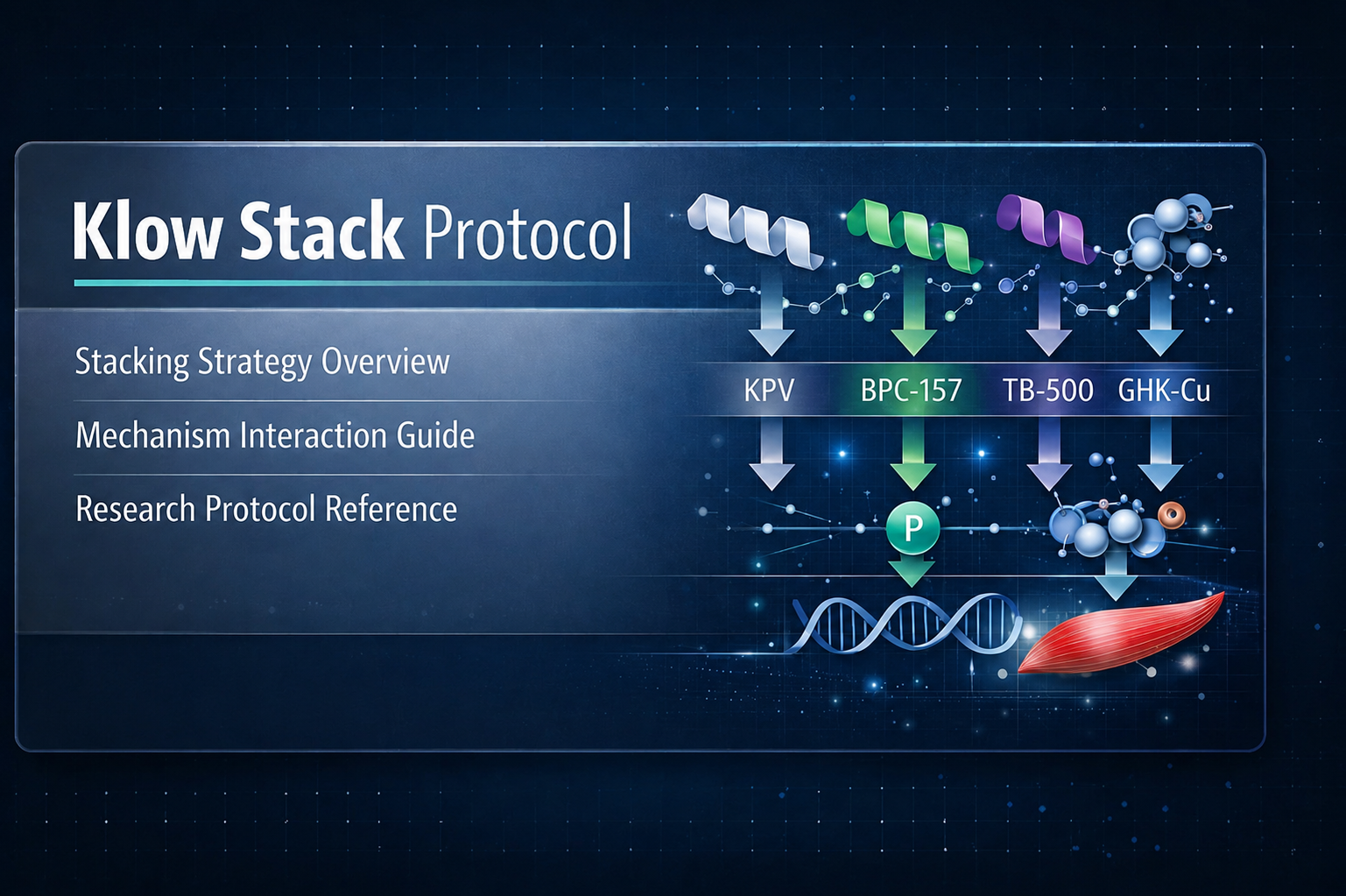
KLOW combines four experimental compounds that are frequently discussed in recovery and longevity communities: KPV, GHK-Cu, BPC-157, and TB-500. Each component targets a different part of the repair process, at least in theory.
The problem is that promising mechanisms are not the same as proven human outcomes.
Research on the individual ingredients ranges from topical human studies to laboratory experiments and animal models. The complete KLOW formula has not been validated as a four-compound recovery treatment in controlled human trials.
Here is what the KLOW protocol contains, why it has attracted attention, where the evidence is promising, and where the marketing may be running ahead of the science.
Educational notice: This article is for informational purposes only. KLOW is not an FDA-approved medication or treatment protocol. It should not replace medical evaluation, rehabilitation, physical therapy, surgery, or other evidence-based care.
What Is the KLOW Protocol?
KLOW is the name commonly given to a blend containing:
It is essentially an expanded version of the better-known GLOW combination. GLOW typically contains GHK-Cu, BPC-157, and TB-500, while KLOW adds KPV to introduce another potential inflammation-modulating pathway.
The reasoning behind the combination is straightforward:
- KPV is included for inflammation and gut-related signaling.
- GHK-Cu is included for collagen, skin, and extracellular-matrix remodeling.
- BPC-157 is included for experimental tissue and gastrointestinal repair.
- TB-500 is included for cell migration and wound-repair signaling.
GET KLOW -> [WELCOME26](https://endurebiolabs.com/?promo=WELCOME26
This creates a compelling biological story. Inflammation is reduced, repair cells are recruited, collagen is remodeled, and damaged tissues receive support from multiple directions.
However, each ingredient has a different level of evidence, safety information, molecular behavior, and regulatory status. Putting them in the same vial does not automatically prove that they work better together.
Why KLOW Looks Compelling on Paper
Recovery is not controlled by one biological switch.
A tendon, muscle, skin wound, or surgical incision must move through several overlapping stages. These include inflammation, cell recruitment, new blood-vessel formation, collagen production, tissue remodeling, and restoration of function.
The proposed appeal of KLOW is that its four components may influence different parts of that process.
That does not yet establish synergy. A true synergistic effect would need to be demonstrated by comparing the complete blend against its individual ingredients and against a placebo or standard treatment.
For now, KLOW’s combined benefits remain a hypothesis built from separate bodies of research.
KPV: The Inflammation Component
KPV stands for lysine-proline-valine. It is a three-amino-acid fragment derived from the end of alpha-melanocyte-stimulating hormone, or alpha-MSH.
Laboratory and animal studies suggest KPV may influence inflammatory pathways without producing the pigmentation effects associated with the full alpha-MSH molecule. In mouse models of colitis, KPV reduced inflammatory changes and supported recovery of the intestinal lining.
These findings explain why KPV is discussed for:
- Intestinal inflammation
- Skin irritation
- Inflammatory signaling
- Mucosal healing
- Gut-barrier support
The critical limitation is that these results have not been confirmed in adequate human clinical trials.
In its July 2026 review, the FDA stated that it had not identified clinical studies or human-exposure data for KPV through any route of administration. The agency concluded that its potential safety risks in humans remain unknown.
KPV may be one of the most interesting components of KLOW, but it is also one of the least clinically characterized.
GHK-Cu: The Collagen and Skin Component
GHK is a naturally occurring tripeptide that binds copper. The resulting GHK-Cu complex has been studied for tissue remodeling, wound repair, collagen regulation, skin elasticity, and antioxidant signaling.
Research reviews describe GHK-Cu as influencing fibroblast activity, extracellular-matrix turnover, collagen production, blood-vessel formation, and several genes associated with tissue repair. Small human studies and cosmetic research provide some support for topical applications in aging skin.
This makes GHK-Cu the KLOW ingredient with the clearest connection to cosmetic skin products.
However, evidence from topical skincare cannot automatically be transferred to injectable use.
The FDA currently identifies injectable GHK-Cu as a substance that may present immunogenicity risks due to aggregation, peptide-related impurities, and limited human safety information. Non-injectable GHK-Cu is evaluated separately under federal compounding policies.
One controlled study also found that topical copper tripeptide did not significantly improve healing after carbon-dioxide laser resurfacing. That result illustrates why biological plausibility does not guarantee a meaningful clinical outcome.
BPC-157: The Experimental Repair Component
BPC-157 is a synthetic 15-amino-acid compound derived from a sequence associated with a protein found in gastric juice.
It has become popular in athletic and injury-recovery communities because animal studies report effects involving:
- Tendon-cell migration
- Fibroblast activity
- Blood-vessel signaling
- Ligament and tendon repair
- Muscle recovery
- Gastrointestinal protection
A frequently cited rat study found that BPC-157 increased tendon fibroblast outgrowth, survival, and migration after injury. More recent reviews describe promising preclinical findings across tendons, muscles, ligaments, and other tissues.
The human evidence is considerably weaker.
A small retrospective study reported subjective improvement among patients who received intra-articular BPC-157 for different forms of knee pain. It lacked randomization, placebo control, blinding, standardized diagnoses, and objective healing measurements.
No established human dose, treatment duration, long-term safety profile, or proven musculoskeletal indication has been established.
BPC-157 is therefore best described as an experimental compound with encouraging preclinical data—not a proven injury-healing treatment.
TB-500: The Cell-Migration Component
TB-500 is generally described as a synthetic fragment related to thymosin beta-4, a naturally occurring protein involved in actin regulation, cell migration, blood-vessel development, inflammation, and wound repair.
Full thymosin beta-4 has been studied in human wound-healing research. Phase 2 investigations have reported potential benefits in certain pressure ulcers, stasis ulcers, corneal injuries, and other difficult-to-heal wounds.
However, TB-500 and full thymosin beta-4 should not be treated as interchangeable.
Commercial TB-500 is commonly identified as the LKKTETQ fragment of thymosin beta-4. Human research involving the complete thymosin beta-4 protein does not prove that the shorter TB-500 fragment produces the same effects, reaches the same tissues, or has the same safety profile.
The FDA has stated that it has not identified human-exposure data for drug products containing the TB-500 fragment. It has also raised concerns about immune reactions, aggregation, impurities, and inadequate safety characterization.
Claims that TB-500 prevents scar tissue, directs repair cells precisely to an injury, or reliably accelerates orthopedic recovery go beyond what controlled human evidence currently demonstrates.
Has the Complete KLOW Blend Been Studied?
This is the most important question.
The research commonly used to promote KLOW comes from studies of its four ingredients separately. Those studies used different:
- Routes of administration
- Doses
- Formulations
- Species
- Injury models
- Treatment durations
- Clinical endpoints
There is no evidence that simply combining the compounds preserves every effect reported in separate experiments.
Mixing several compounds can also introduce new questions:
- Do the ingredients remain chemically stable together?
- Does copper from GHK-Cu affect the other molecules?
- Do the components degrade at different rates?
- Does one ingredient alter the absorption of another?
- Are adverse immune reactions more likely?
- Does the fixed ratio provide an appropriate amount of every ingredient?
Until the complete formulation is tested, claims of superior synergy, full-body healing, autoimmune support, increased energy, or accelerated post-surgical recovery should be viewed as marketing hypotheses.
The same applies to timelines claiming noticeable results in two or three weeks and deeper healing within six to twelve weeks. These timelines have not been established through controlled trials of the KLOW protocol.
KLOW vs. GLOW: What Is the Difference?
The distinction is simple:
GLOW generally includes:
- GHK-Cu
- BPC-157
- TB-500
KLOW generally includes:
- GHK-Cu
- BPC-157
- TB-500
- KPV
The added KPV is intended to expand the blend’s focus toward inflammatory and gastrointestinal signaling.
That does not mean KLOW is automatically stronger or better. It means it exposes the user to an additional experimental compound with limited human safety data.
More ingredients can mean broader theoretical activity, but they can also create more uncertainty.
Potential KLOW Risks
Because the complete blend lacks controlled human trials, there is no reliable estimate of how frequently side effects occur.
Potential concerns include:
- Injection-site pain, swelling, or irritation
- Allergic or immune reactions
- Contamination or sterility failures
- Incorrect ingredient concentrations
- Peptide degradation or aggregation
- Unexpected interactions between ingredients
- Uncertain effects on blood-vessel growth
- Unknown long-term consequences
- Delayed diagnosis or treatment of a serious injury
Theoretical benefits involving angiogenesis, inflammation suppression, and cellular migration are also reasons that long-term safety requires study. A pathway that assists normal repair in one setting may not be desirable in every medical condition.
People with active medical conditions, unexplained pain, recent surgery, immune disorders, pregnancy, breastfeeding, a history of severe allergic reactions, or active cancer concerns should not treat KLOW as a substitute for individualized medical care.
What Competitive Athletes Need to Know
KLOW presents a major anti-doping problem.
The 2026 World Anti-Doping Agency Prohibited List includes BPC-157 under the category of non-approved substances. Thymosin beta-4 and its derivatives, including TB-500, are also prohibited.
Because KLOW contains both BPC-157 and TB-500, athletes competing under WADA-aligned rules should treat the entire blend as prohibited.
A product being prescribed, compounded, sold by a clinic, or labeled “natural” does not automatically make it permissible under anti-doping rules. Athletes remain responsible for prohibited substances detected in their samples.
Check out our recommended research supplier here
Questions to Ask Before Considering KLOW
Anyone evaluating a provider offering the KLOW protocol should ask:
- Is this being supplied by a state-licensed pharmacy?
- Is the product intended for human use or labeled for research only?
- What exact amount of each ingredient is present?
- Has the complete blend undergone sterility and endotoxin testing?
- Is there an independent certificate of analysis?
- What human evidence supports the proposed medical use?
- How will progress and adverse reactions be monitored?
- What medications or health conditions could create additional risk?
- What evidence-based treatments should be tried first?
- Is the provider presenting animal findings as though they were proven human results?
A certificate of analysis can help confirm identity or purity, but it cannot prove that a blend is safe or effective.
Bottom Line
The KLOW protocol combines four biologically interesting compounds into one recovery-focused formula.
GHK-Cu has meaningful research behind its role in skin and tissue remodeling, particularly in topical applications. KPV has demonstrated anti-inflammatory activity in laboratory and animal models. BPC-157 has promising preclinical findings involving several forms of tissue repair. Full thymosin beta-4 has human wound-healing research, although that evidence cannot automatically be applied to the shorter TB-500 fragment.
What remains missing is high-quality evidence for the actual KLOW blend.
There are no established human dosing standards, proven treatment timelines, long-term safety data, or controlled trials showing that the four ingredients work better together. The recent FDA advisory committee vote may eventually influence access through compounding pharmacies, but it does not make KLOW FDA-approved or clinically validated.
KLOW may represent an interesting research concept. It should not yet be presented as a proven shortcut for healing, inflammation, energy, gut health, or injury recovery.