
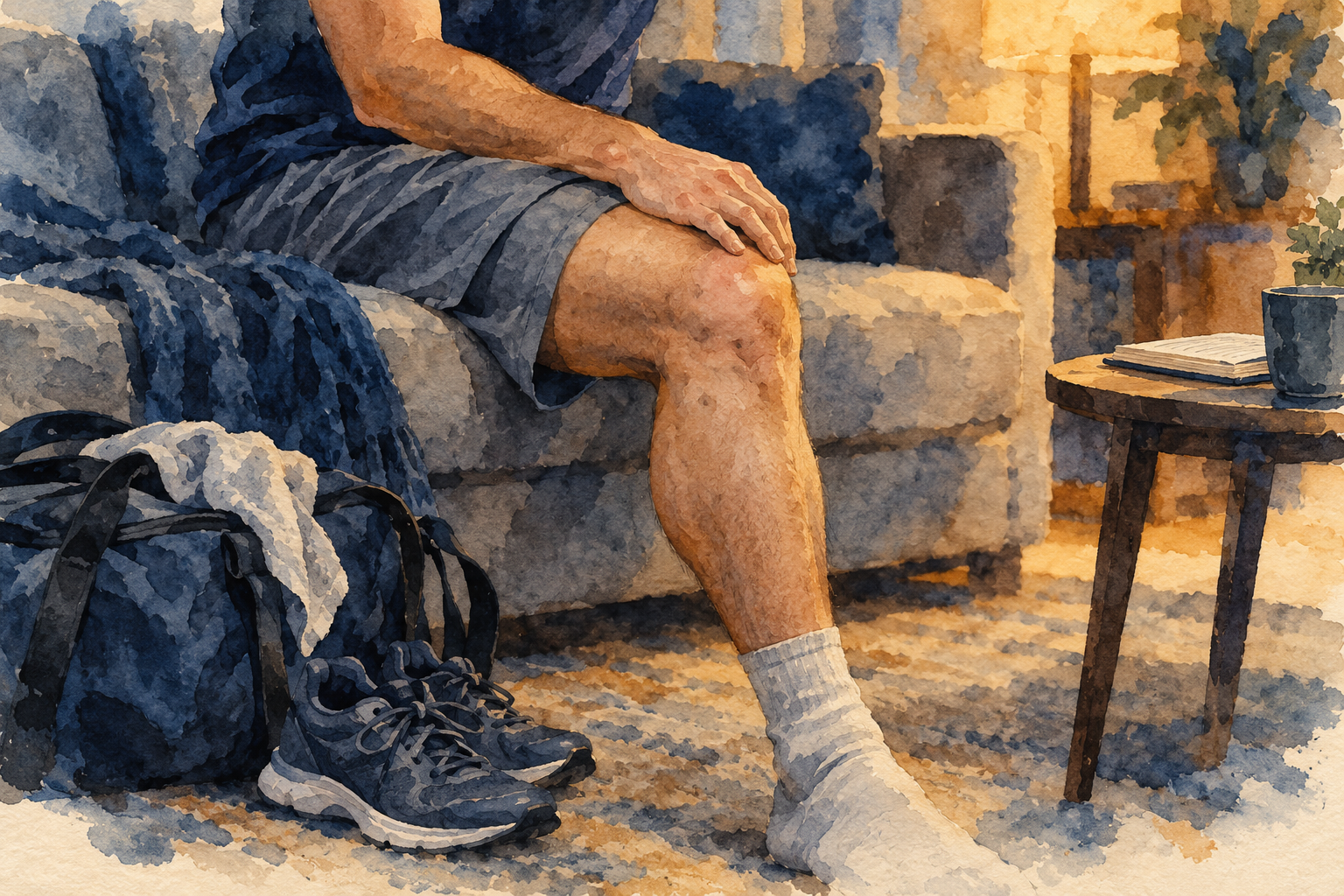
Imagine leaving the gym thinking, finally, that your knee is starting to feel like yours again. By dinner, it looks fuller, and you are replaying the extra set you added because everything felt good.
The frustration is not just the swelling. It is wondering whether another good day has turned into another restart.
If you are in later-stage rehabilitation after ACL reconstruction and have been cleared for gym activity, the useful distinction is this: a session can feel manageable while you are doing it and still need adjusting once you see the response afterward. New swelling deserves attention, but it cannot, by itself, tell you whether the graft is damaged. Its appearance or timing cannot rule out a problem, either.
The next step is to give that response some context—and bring it into the plan before adding more.
The workout does not end when you leave the gym
During a session, you notice whether a movement hurts, whether the weight moves, and whether you can finish. Later, you get different information: swelling, stiffness, a changed walking pattern, or stairs that feel harder.
Those observations belong beside the repetitions in your training log.
The Aspetar ACL rehabilitation guideline describes progression as individual and criteria-based, while still respecting time needed for graft protection and healing. It also acknowledges limited evidence on the exact relationship between exercise dose and outcomes.
That matters because there is no universal number of sets that every reconstructed knee should tolerate at a particular month.
Your operation matters, too. ACL reconstruction with an additional meniscus repair may come with restrictions that do not apply to an isolated ACL procedure. Follow your team's plan rather than borrowing a timeline from someone who had a different operation.
Why swelling is worth noticing even when pain is mild
An effusion is extra fluid inside a joint. Visible puffiness is not enough to determine exactly where fluid is or what caused it; that requires assessment.
Researchers have shown that experimentally creating a knee effusion can affect the quadriceps—the large muscles at the front of the thigh. In a 2013 crossover experiment involving 14 healthy volunteers, both induced pain and induced joint fluid reduced quadriceps activation and strength compared with the normal-knee condition.
This was a laboratory model, not a study of people returning to the gym after surgery.
The clinical picture is less tidy. A study of 41 people assessed before and approximately 16 weeks after ACL reconstruction found a small relationship between larger effusions and lower quadriceps activation after surgery, but no relationship with measured strength. Its authors cautioned that simulated-effusion studies may overestimate the effects seen in patients.
The useful takeaway is modest: swelling is relevant information, not a complete strength test or an injury diagnosis. A knee that is not especially painful can still deserve a closer look when its response changes.
Give your physio more than “I overdid it”
“I overdid it” expresses the frustration. It leaves the adjustable part unclear.
Was the weight heavier? Were there more repetitions? Did you introduce a new exercise, train on consecutive days, or spend the afternoon on your feet?
A short record makes the next conversation more useful:
| When | What to record |
|---|---|
| Before the session | Usual swelling or stiffness; whether walking and stairs felt normal for you. |
| During the session | Exercises, sets, repetitions, resistance, and anything new. |
| That evening | When swelling became noticeable; pain, stiffness, or a change in everyday movement. |
| The next morning | Whether symptoms settled, persisted, or worsened; what feels different from your usual baseline. |
You do not need to measure your knee repeatedly or grade an effusion yourself. Ordinary descriptions are useful: “I could straighten it comfortably beforehand; afterward it felt harder,” or “Walking was normal, but stairs were different.”
This is a communication tool, not a validated diagnostic test. Do not wait to complete it if symptoms need prompt care.
Make the next session a planned decision
If swelling is new or greater than your usual response, pause the planned increase and contact your physiotherapist or surgical team for guidance. Use any symptom-response instructions they have already given you.
The question is not simply whether to train or stop everything. Ask which activities remain appropriate, which part of the session should change, and what response they want before you progress again.
For example, imagine that your cleared program had been going well until you added both resistance and an extra set. Your record gives the therapist something specific to review. It does not prove either change caused the swelling, but it helps them decide what to assess and adjust.
A criterion-based ACL rehabilitation paper includes effusion and other clinical measures in progression decisions. Its value here is the principle: meeting milestones involves more than completing an exercise once. The paper is an established clinical framework, not a personalized prescription for your next workout.
Try these three questions:
- What change in swelling or function means I should contact you before the next session?
- Which part of my current program should I keep, reduce, or temporarily leave out?
- What should be true before I increase the demand again?
If the uncertainty is wearing you down as much as the knee itself, our personal account of lessons after knee surgery explores that side of the return.
When to get assessed promptly
Seek urgent assessment for severe pain, marked swelling, inability to move the knee or bear weight, or new locking or giving way. A hot or red knee with fever also needs urgent attention; these are among the symptoms listed in NHS knee-pain guidance.
After surgery, worsening redness or swelling, wound drainage, fever, or new throbbing or cramping leg pain can require urgent review for complications. The NHS ACL-surgery guidance also identifies leg pain and swelling with chest pain or breathing difficulty as an emergency. In the US, call 911 for those emergency symptoms.
Do not treat these signs as an ordinary training response or wait for your next routine appointment.
References / Sources
- Aspetar: Recommendations on rehabilitation after ACL reconstruction. Guideline recommendations and individual progression.
- Palmieri-Smith and colleagues, 2013: Pain, effusion and quadriceps function. Experimental study in healthy volunteers.
- Johnson and colleagues: Effusion and quadriceps function after ACL injury and reconstruction. Original abstract inspected; observational relationships.
- Adams and colleagues, 2012: Criterion-based ACL rehabilitation progression. Clinical framework.
- NHS: Knee pain and complications of ACL surgery. Symptoms requiring assessment.
The Bottom Line
A good session is encouraging. The knee's response afterward helps decide what comes next.
If swelling appears, record what changed, follow your team's symptom-response plan, and get advice before increasing the demand. You do not have to decide, alone on the sofa, whether the whole comeback has failed.
For more plain-language research about rebuilding activity, join The Rebuild through the Outlast homepage signup. It offers educational emails on performance, recovery and longevity.
The goal is to build a week you can return to—not just finish one workout.