
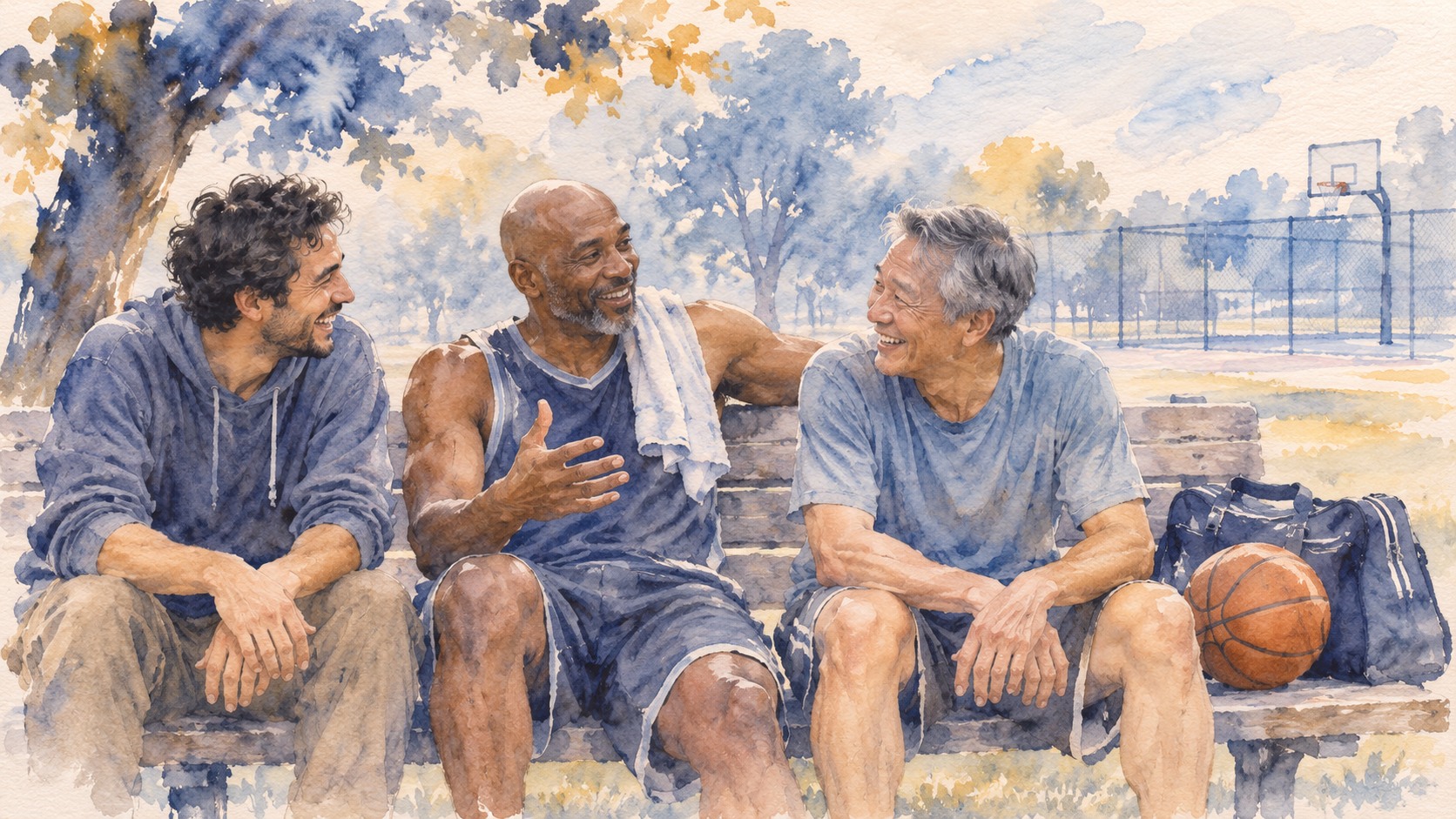
You know those twenty minutes after a game when the score is settled but nobody has quite gone home? Someone asks about your week, an old joke starts again and you stay a little longer than you meant to.
When the game drops out of your week, those conversations can go with it.
You might still be exercising. You might be taking time away, adapting after an injury or working hours that no longer fit the session. What you miss is partly the activity and partly the people who came with it.
Getting back to the activity and seeing your friends can happen at different times. You can make a plan to see your people before you have a plan to play again.
Here's a way to arrange a catch-up without leaving anyone guessing whether you're going to play.
The game carried more than one thing
A regular session gives friendship a place to happen. You don't have to arrange a separate catch-up each week; you see the same people because you share the activity.
That doesn't make every sporting group a close-knit family. Sometimes what you value is simply being recognised, exchanging a few words and having a familiar place in the week.
In a 2024 interview study of parkrun in Ireland, 39 men aged 45–64 described their experiences as runners, walkers or volunteers. They described different levels of social connection, from looser acquaintances to stronger ties, with social engagement evolving through repeated participation.
The study explored those men's experiences. It didn't test a treatment for loneliness. What it adds here is a useful distinction: the people you miss don't all have to be close friends. The familiar faces count too.
If you're unsure which part matters most, our activity-values map for a changing athletic life can help you name it. Once you know whom you want to see, the next step is a more concrete invitation.
Make a plan your friends can understand
“Come along” can mean watching, catching up afterward or being available if the team is short. Agreeing on the meaning beforehand saves everyone some guesswork.
Decide on three parts:
| Part | Make it concrete |
|---|---|
| Place | Where can we spend time together: the venue, a café afterward or a call from home? |
| Expectations | What am I coming for? What am I not doing? |
| Exit | When do I need to leave, and how can I get home or change the plan? |
Choose somewhere that fits your circumstances. Check seating, access and transport if they matter to you. “Just watching” can still involve a long walk from the car or an afternoon standing around.
If you're recovering from injury or surgery, choose a plan that fits your current restrictions. Ask your treating professional about any demands you're unsure of. Coming along to see your friends doesn't change what you're cleared to do.
Turn “sometime” into an invitation
Say you've been away from your weekly basketball game. You miss two friends and would like to see them, but you're not planning to play.
“Maybe I’ll come down sometime” leaves the timing and expectations open. Here is a more definite option:
I miss catching up with you. Could I meet you and Jo at the café after Saturday’s game? I’m coming for a chat, not to play. I can stay about half an hour.
In this example, half an hour is just the time you've chosen for a catch-up. Pick a time and place that work for you, check how you'll get home and agree when to meet so a late game doesn't leave you waiting at the court.
If a friend replies, “We might need one more,” the answer can stay simple:
I’m keeping this visit social. I’d still like to see you afterward.
Now your friends know what you're coming for and when you'll leave. Nobody needs an answer about next week's game.
If the pressure continues, you can meet one friend elsewhere or choose another day. You don't have to keep explaining.
You don't have to earn the invitation
You may enjoy helping at a session. You also deserve company without becoming the equipment carrier, organiser or emergency substitute.
If a role appeals to you, ask what it actually involves. “Helping out” tells you little about lifting, walking or time on your feet.
Research also reminds us that company and helpful support are not interchangeable. In a qualitative study of 12 Canadian university swimmers, athletes described caring support alongside experiences of being doubted or pushed to train through injury. The findings describe those swimmers' experiences, not every team or recreational group.
The practical point is to choose people who respect what you have said. Being glad to see you does not require negotiating you into a game.
If you're extending the invitation, offer a clear social option: “Would you like to join us afterward? No need to play.” Then accept the answer without turning it into a pep talk.
Make room for a different answer
Watching may feel good. It may also sharpen the frustration of being away.
You can miss your friends and prefer to see them somewhere else. A meal, a brief call or a conversation at home can keep the friendship separate from the setting you're not ready to revisit.
You can also say, “I'd like to catch up, but I don't want the whole conversation to be about when I'm coming back.”
Afterward, ask two questions: Did I get the kind of company I wanted? What would make the next visit fit better?
Maybe the answer is the same café next week. Maybe it is a smaller group or a call instead. You are looking for contact you would welcome again, without having to perform cheerfulness or prove readiness.
You don't need a recovery milestone to have something worth talking about. Friendship is worth making room for on its own terms.
References / Sources
- Dunne and colleagues, 2024: “My parkrun friends”. Qualitative interviews with 39 men aged 45–64 in Ireland.
- Abgarov and colleagues, 2012: Social support throughout injury among university swimmers. Qualitative interviews with 12 Canadian university swimmers.
The Bottom Line
Choose one person you miss. Suggest a place, explain what you're coming for and make the timing clear.
That is enough for one invitation. You don't have to settle your sporting future before asking someone to spend time with you.
If you're figuring out how activity fits into your life now, subscribe to The Rebuild. It's our educational newsletter on performance, recovery and longevity, for people who want to keep doing what they love.
The game may be absent from your week. The conversation does not have to be.
Do what you love for longer.