
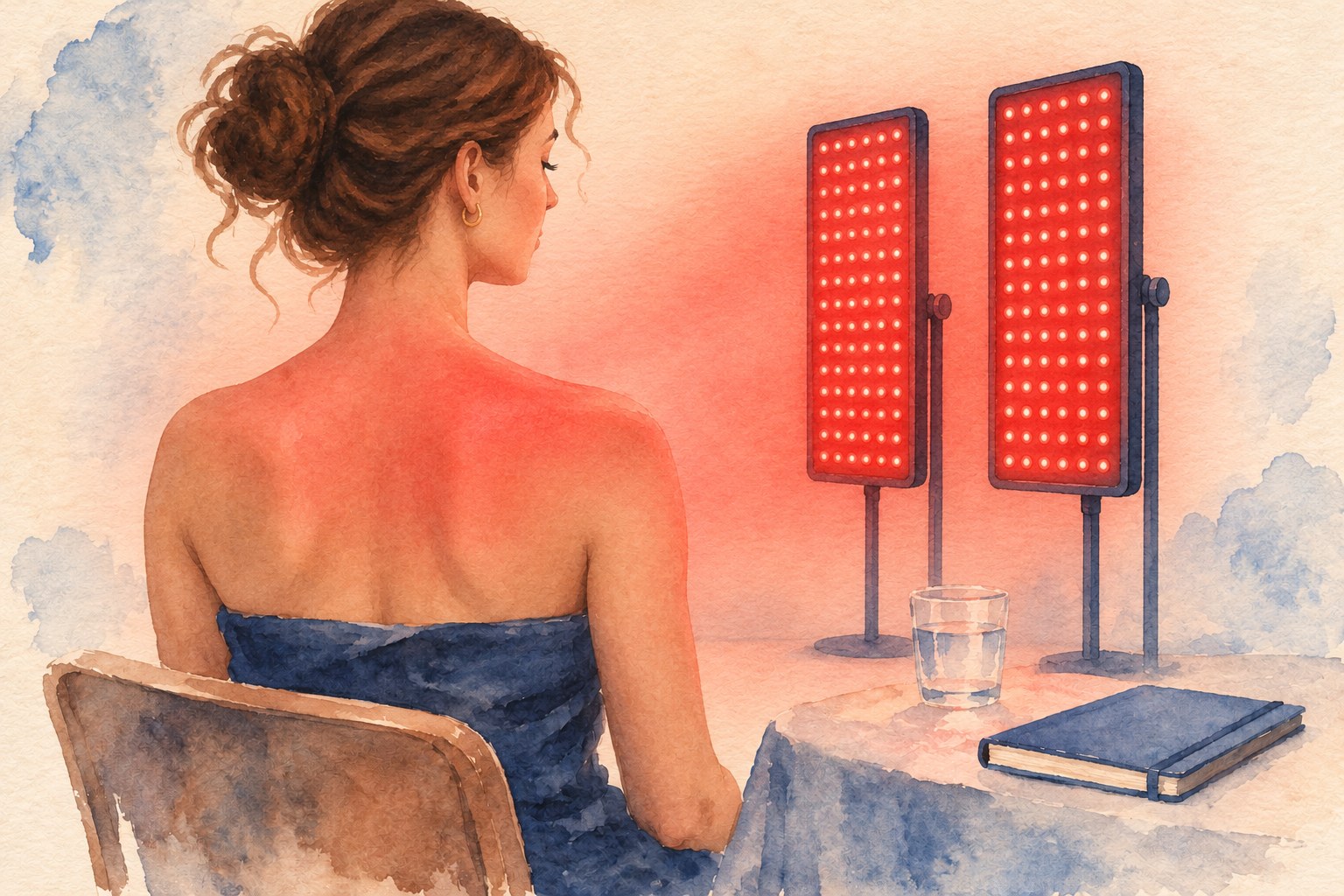
A light aimed at someone's back seems an unlikely way to change what happens to a sugary drink. Yet that is the experiment Andrew Huberman brings up early in his conversation with The Diary of a CEO. Around 14 minutes in, the discussion moves from morning daylight to a much stranger possibility: light reaching the skin might affect glucose handling.
For anyone already paying attention to food, training and metabolic health, that is an appealing possibility. It is also a puzzling one. The light never touches the drink. So what is changing?
The answer begins with a small human experiment and a result that is easy to misquote.
What happened under the light
In 2024, Michael Powner and Glen Jeffery studied 30 healthy adults. Fifteen received 670-nanometer red light on their upper backs for 15 minutes, starting 45 minutes before a glucose challenge. Fifteen underwent the same setup with the light off. Participants drank 75 grams of glucose and had blood sugar measured over two hours. [1]
The light group had a smaller glucose response. The widely repeated 27.7% reduction describes the rise above fasting glucose integrated across those two hours. It does not mean the highest reading fell by 27.7%.
Peak glucose fell 12.1% compared with the placebo group. A separate comparison against the light participants' own earlier tests showed a 7.5% lower peak. Those are different comparisons, not competing versions of one number. [1]
Think of a glucose curve as a hill. Its summit tells you the peak; the area above the starting level includes both its height and how long the elevation lasts. A headline that calls both a "spike" hides that distinction.
In the interview, the larger percentage is described as a peak reduction. The study separates those outcomes. Keeping them separate lets us appreciate the result without enlarging it.
Why light might change glucose handling
The researchers proposed that light could influence mitochondria, the cells’ energy-producing structures, increasing glucose demand. The experiment did not directly establish that whole chain in its volunteers. [1]
The light is not being proposed as a way to remove sugar from a drink. The question is whether it changes how tissue handles the fuel that reaches it. That gives researchers something specific to investigate: where the glucose goes and which biological processes change along the way.
It also helps explain why the details of an experiment matter. Wavelength, exposure and the tissue receiving the light are part of the intervention. "Red light" on a shopping page does not tell you whether the product reproduces a study.
This also gives us a reason to keep the interview’s daylight discussion separate from the skin experiment. Getting outside in the morning and directing a particular wavelength at the back are different exposures. Evidence for one cannot simply be borrowed to promise the other’s result.
And if you came to this through sport or recovery, glucose handling is only one part of your question. The healthy-volunteer trial did not test endurance or recovery. Those benefits would need to be measured.
What happened when researchers studied diabetes?
A separate 2023 crossover trial involved 10 adults with type 2 diabetes. Each participant completed six conditions combining sham or two doses of 830-nanometer near-infrared light with or without their usual oral glucose-lowering medication. The light was applied to several muscle areas and glucose was followed after a standardized meal. [2]
The published abstract reported the strongest glucose reduction at the lower active dose in the conditions without medication, with effects lasting up to 12 hours. Results with medication were more complicated: glucose declined similarly across doses, although an integrated glucose measure favored the lower dose. [2]
The lower dose performing better is a useful complication. If more light were automatically better, there would be much less to work out. Instead, the dose and medication context appear to matter. This was a small research protocol, not an instruction to interrupt medication.
This study also changes the story from "a red-light result" to a more specific research problem. The wavelength, exposed muscles, meal and participants differed from the healthy-volunteer experiment. The two trials are related, but they do not test the same intervention twice.
The distance between an experiment and your dinner
The question that remains is practical: does a repeatable laboratory effect become a useful benefit in ordinary life?
A 2026 systematic review found inconsistent metabolic results across trials, with different treatment setups and follow-up periods. Some studies suggested short-term glucose changes; longer-term results were not consistent enough to establish a dependable metabolic benefit. [3]
The healthy-volunteer study used a glucose drink, so the everyday-meal question also needs its own answer. A mixed meal is a different test. Beyond that, a useful treatment would need a benefit that persists with repeated use, a reproducible setup and a clear understanding of who benefits while continuing their usual care.
The missing link is repeatability in the setting where someone would actually use it.
For now, this research gives a curious reader a better question to ask of a device claim: Which human trial tested this setup, in people like me, for the outcome I care about? A citation about a glucose drink does not automatically answer a question about diabetes management or athletic recovery.
If you manage diabetes, discuss an interest in light therapy with your clinician before using it to influence your treatment. These studies do not provide a basis for replacing prescribed care.
References / Sources
- Powner MB, Jeffery G. Light stimulation of mitochondria reduces blood glucose levels. Journal of Biophotonics. 2024. Full study inspected.
- Scontri CMCB et al. Dose and time-response effect of photobiomodulation therapy on glycemic control in type 2 diabetic patients. Journal of Biophotonics. 2023. Findings summarized from the published abstract.
- Wevers A et al. Effects of Photobiomodulation on Metabolic, Inflammatory, and Neurological Outcomes in Type 2 Diabetes. International Journal of Molecular Sciences. 2026;27(1):440. Published online December 2025.
- Andrew Huberman on The Diary of a CEO. Discussion beginning around 13:35; source of the opening question, not proof of treatment effectiveness.
The Bottom Line
Light on the skin affecting blood sugar is a serious research question, with early human findings worth following. The next discovery that would make this more useful is a reliable benefit that survives repeated testing in everyday conditions. For now, the finding earns our attention. What would earn it a place in a routine is knowing which setup reliably helps which person, and by enough to matter.