
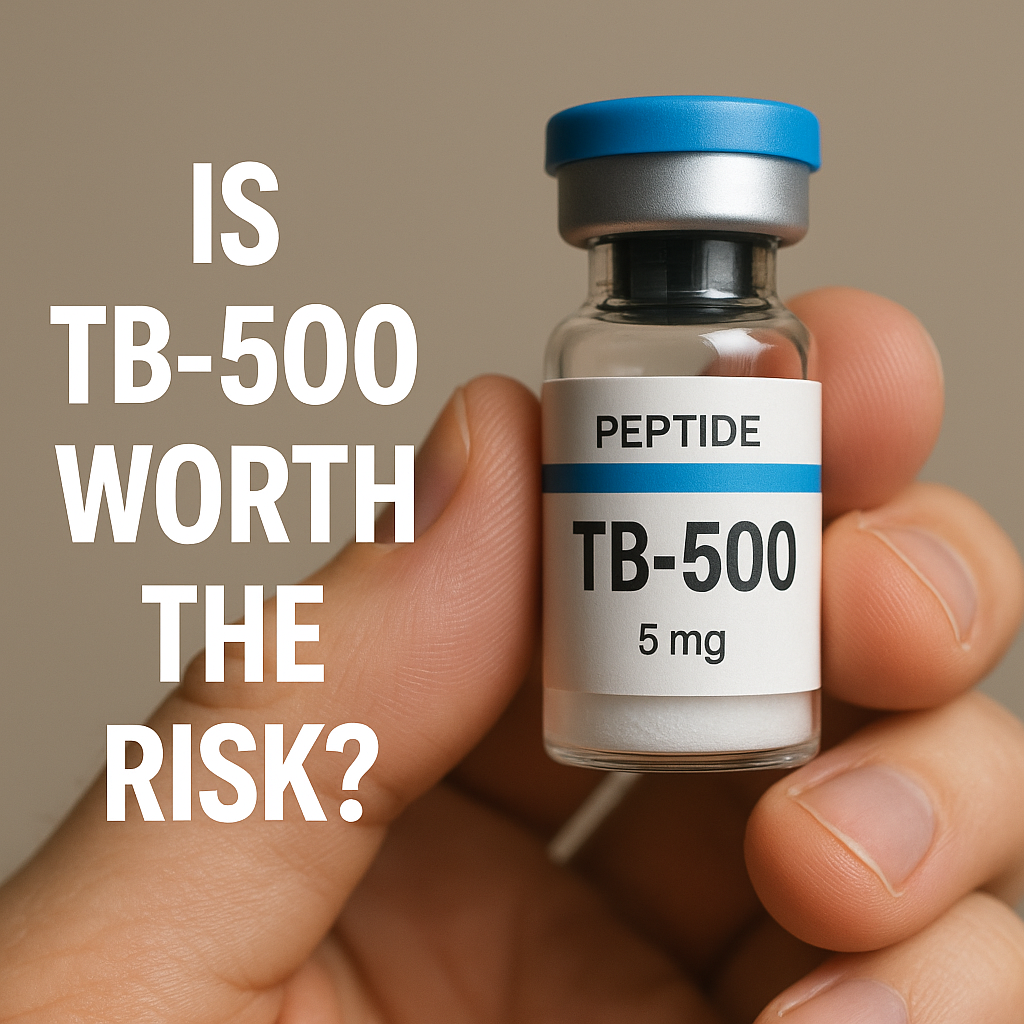
When an injury keeps you from training, promises of faster healing become difficult to ignore. That is one reason TB-500 recovery protocols have gained so much attention among athletes, bodybuilders, and active adults.
Online, TB-500 is promoted for tendon healing, muscle recovery, reduced inflammation, improved flexibility, and faster rehabilitation after surgery. It is also frequently combined with BPC-157 in what is sometimes called the “Wolverine stack.”
The biological theory is interesting. The human evidence is far less convincing.
Much of the research used to support TB-500 involves a different molecule called thymosin beta-4. Other evidence comes from cells, rodents, or horses rather than injured human athletes. As of August 2026, researchers still do not have controlled human trials showing that injectable TB-500 repairs tendons, ligaments, muscles, or joints.
Here is what TB-500 is, why it has become popular, and where the evidence currently stands.
What Is TB-500?
TB-500 is a synthetic seven-amino-acid fragment associated with thymosin beta-4, commonly abbreviated as Tβ4. Its sequence corresponds to amino acids 17 through 23 of the larger thymosin beta-4 molecule.
Thymosin beta-4 is a naturally occurring 43-amino-acid protein found throughout the body. It participates in processes involving actin regulation, cell movement, inflammation, blood-vessel development, and tissue repair.
TB-500 is not simply another name for thymosin beta-4.
The commercial compound identified as TB-500 is generally an N-terminal-acetylated version of the smaller LKKTETQ sequence. That chemical difference matters. A fragment may not behave like the complete protein, and acetylation can alter a molecule’s stability, charge, metabolism, and biological activity.
FDA reviewers have also noted that products sold under the TB-500 name may use inconsistent terminology. Free-base forms, acetate forms, fragments, and other thymosin-related products are sometimes described as though they were interchangeable, even though their physical and pharmacological properties may differ.
Why TB-500 Recovery Claims Sound Plausible
The theory behind TB-500 begins with actin.
Actin is a structural protein that helps cells maintain their shape, move, divide, and respond to damage. The LKKTET region of thymosin beta-4 is associated with actin binding. Because cell migration is important during tissue repair, researchers have explored whether thymosin-related compounds could support wound closure and regeneration.
Studies involving thymosin beta-4 have reported potential effects on:
- Cell migration
- Inflammatory signaling
- Collagen deposition
- Blood-vessel formation
- Skin and corneal wound healing
These findings provide a biological reason to study thymosin-related compounds. They do not prove that injectable TB-500 accelerates recovery from a torn tendon, strained muscle, ligament injury, or orthopedic surgery.
That distinction is where many online explanations become misleading.
TB-500 and Thymosin Beta-4 Are Not the Same Evidence
Some human research has been conducted with full-length thymosin beta-4.
For example, topical thymosin beta-4 has been investigated in patients with pressure ulcers, venous ulcers, and persistent eye-surface injuries. Some studies reported encouraging wound-healing signals, although several were small or focused on very specific medical conditions.
Those studies do not establish that injected TB-500 heals sports injuries.
They used a different molecule, different formulations, different delivery methods, and different clinical outcomes. Applying a full-length protein to a skin or corneal wound is not equivalent to injecting a seven-amino-acid fragment for systemic tendon or muscle recovery.
The FDA’s 2026 review made this separation clear. The agency found that studies submitted in support of TB-500 largely involved thymosin beta-4 or related non-acetylated fragments—not TB-500 administered to human patients.
What Laboratory and Animal Studies Show
Early research has produced mixed results.
A non-acetylated LKKTETQ fragment was tested topically in an aged-mouse wound model. The study reported improved epidermal closure and collagen content. However, the FDA cautioned that the results may not transfer directly to acetylated TB-500, injectable use, or other types of injuries.
The FDA also reviewed a laboratory experiment using TB-500 on cultured fibroblast cells. In that experiment, TB-500 did not significantly improve closure of a scratch-generated wound compared with the control. One smaller TB-500 metabolite showed a modest effect, but its relevance to human recovery remains unknown.
Animal metabolism research has largely focused on horses and rodents. These studies help anti-doping laboratories identify TB-500 and its metabolites. They do not demonstrate clinical recovery benefits in humans.
The most accurate interpretation is that TB-500 has a proposed biological mechanism and limited preclinical findings. It does not yet have clinical proof for orthopedic recovery.
Does TB-500 Heal Tendons, Ligaments, or Muscles?
There are currently no high-quality human trials showing that TB-500 speeds the healing of:
Achilles or patellar tendons Rotator-cuff injuries ACL or other ligament injuries Muscle strains or tears Postoperative orthopedic tissue Chronic joint pain
A 2026 sports-medicine review concluded that thymosin beta-4 and TB-500 showed regenerative potential in preclinical models, but human orthopedic data were lacking. The authors stated that more safety and effectiveness research was required before clinicians could make definitive recommendations.
This does not prove that TB-500 has no biological effect. It means the size of any effect, the conditions it might help, the appropriate patient population, and the risk-to-benefit ratio remain unknown.
Anecdotes cannot answer those questions. An injury may improve because of time, physical therapy, reduced training load, surgery, improved sleep, placebo effects, or several interventions used at once.
TB-500 Dosage Is Not Clinically Established
Online protocols often provide exact schedules, loading phases, injection frequencies, and stacking instructions.
Those schedules are not based on validated human dosing trials.
The FDA reported finding no clinical pharmacokinetic or pharmacodynamic studies evaluating TB-500 in humans through any route of administration. It also found no clinical studies establishing an effective dose for wound healing or another medical condition.
Without controlled studies, researchers cannot confidently define:
- A therapeutic dose
- An effective treatment duration
- An appropriate injection frequency
- A safe cumulative exposure
- Whether subcutaneous and intramuscular use behave differently
- Whether repeated cycles create additional risks
A very specific online protocol may look scientific because it includes numbers. Precision does not make an unsupported dosing schedule evidence-based.
Side Effects and Long-Term Risks
TB-500 does not have a reliable human safety profile.
Headaches, fatigue, appetite changes, nausea, and injection-site reactions are sometimes mentioned online. However, these reports are mostly anecdotal. They cannot establish how common an effect is, whether TB-500 caused it, or whether contamination and incorrect labeling contributed.
FDA reviewers found no human exposure studies that could establish the compound’s safety. They also found no adequate repeat-dose toxicity, reproductive toxicity, genotoxicity, or carcinogenicity studies for TB-500 free base or TB-500 acetate.
Injectable products create additional concerns. Peptides can degrade or aggregate because of heat, pH, concentration, formulation, manufacturing conditions, or improper storage. Aggregates and peptide-related impurities may increase the risk of an immune reaction.
Unknown risk is not the same as confirmed danger. It is also not evidence of safety.
Product Purity May Be as Important as the Compound
Products labeled “for research use only” are not automatically manufactured to pharmaceutical standards.
In one published analysis, researchers examined products marketed online as TB500, TB1000, and SGF1000 and described problems involving misbranding and adulteration.
The FDA has also raised concerns about inconsistent TB-500 naming, incomplete certificates of analysis, peptide impurities, aggregation, bacterial endotoxins, and inadequate characterization of products offered commercially.
A purity percentage from a basic HPLC test does not answer every quality question. It may not confirm sterility, endotoxin levels, aggregate formation, exact peptide identity, potency after storage, or the presence of every related impurity.
For an injectable product, those omissions matter.
The 2026 FDA Review: What Actually Changed?
TB-500 received major attention during the FDA Pharmacy Compounding Advisory Committee meeting held on July 23 and 24, 2026.
The committee evaluated TB-500 free base and TB-500 acetate for possible inclusion on the Section 503A Bulks List, with wound healing as the proposed use. The advisory committee reportedly voted in favor of recommending inclusion.
That vote did not make TB-500 FDA approved.
It also did not prove that the compound is effective, establish an approved dosage, or create an FDA-reviewed medication. Advisory committee recommendations are part of the regulatory process. The FDA must still consider the committee’s input and complete its review before making a final determination.
The committee’s recommendation was especially notable because FDA staff had recommended against adding TB-500 to the list. Their briefing document cited poor product characterization, lack of human effectiveness data, unknown human safety, and potential immunogenicity from injectable use.
As of August 2, 2026, TB-500 remains unapproved for treating injuries or any other medical condition.
Check out our recommended research supplier here
TB-500 and the “Wolverine Stack”
TB-500 is frequently paired with BPC-157.
The marketing explanation is usually that BPC-157 supports localized tissue repair while TB-500 provides broader or systemic recovery. This may sound complementary, but the combination has not been validated in controlled human trials.
Combining two experimental compounds does not correct the evidence gaps surrounding either one. It also makes side effects harder to interpret because users cannot easily determine which substance—or which contaminant—produced an effect.
There is no established human evidence showing that the TB-500 and BPC-157 combination heals orthopedic injuries better than rehabilitation alone.
Competitive Athletes Need to Know the Anti-Doping Rules
TB-500 is prohibited under the World Anti-Doping Agency’s rules.
The 2026 Prohibited List includes thymosin beta-4 and its derivatives, including TB-500, in the growth-factor and growth-factor-modulator category. It is prohibited both in and out of competition.
This applies even though TB-500’s performance benefits remain unproven.
Tested athletes should not assume that a “research only” label, wellness-clinic recommendation, or experimental status protects them from an anti-doping violation.
What to Do When Recovery Is Taking Too Long
Slow recovery does not always mean your body needs a more aggressive compound.
Pain that continues for weeks can reflect an incomplete diagnosis, excessive training load, poor exercise selection, inadequate rehabilitation, low energy availability, insufficient sleep, or a structural injury requiring medical evaluation.
Bottom Line
TB-500 recovery claims are built on a scientifically interesting idea, but the evidence often gets overstated.
Thymosin beta-4 has legitimate biological functions and some human research in specialized wound-healing settings. TB-500 is a smaller, chemically modified fragment, and those findings cannot automatically be transferred to injectable use for tendons, muscles, ligaments, or postoperative recovery.
The FDA has found no clinical studies establishing TB-500’s effectiveness, dosing, pharmacology, or safety in humans. The favorable 2026 advisory committee vote may influence future compounding policy, but it was not FDA approval and did not resolve the scientific uncertainties.
For athletes, the evidence remains preliminary, the product-quality risks are real, and TB-500 remains prohibited under anti-doping rules.
This article is for educational purposes only and is not medical advice. TB-500 is an experimental compound without an FDA-approved medical indication.
Sources FDA, Evaluation of TB-500-Related Bulk Drug Substances for Inclusion on the 503A Bulks List, 2026. Mayfield CK et al., Injectable Peptide Therapy: A Primer for Orthopaedic and Sports Medicine Physicians, 2026. Ho ENM et al., Doping Control Analysis of TB-500, 2012. Treadwell T et al., The Regenerative Peptide Thymosin β4 Accelerates Dermal Healing, 2012. Delcourt V et al., TB500/TB1000 and SGF1000: Misbranded and Adulterated Drugs, 2023. World Anti-Doping Agency, 2026 Prohibited List.