
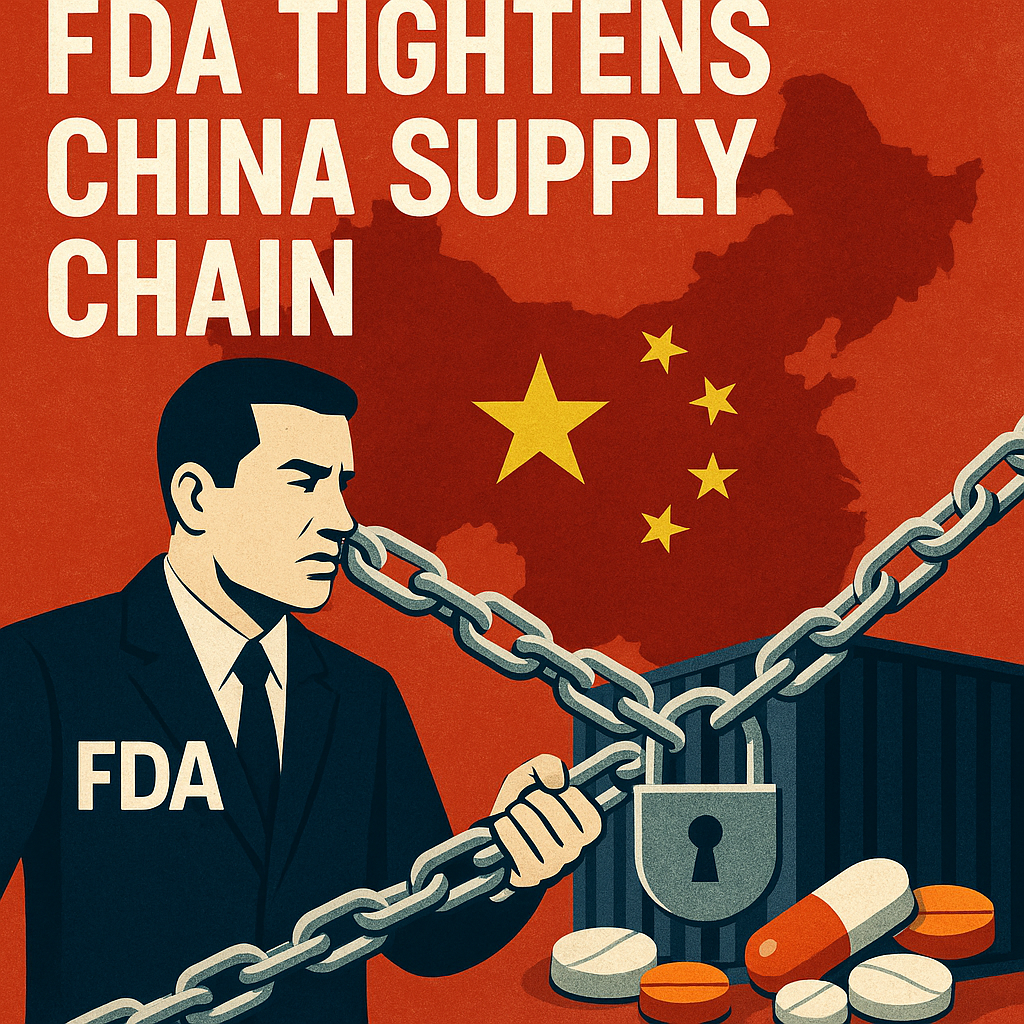
China’s late-September and October holidays are approaching at the same time that U.S. regulators and customs officials are increasing scrutiny of imported peptides and GLP-1 active ingredients. The holidays themselves are routine. The regulatory environment surrounding them is not.
For anyone following the peptide research market, the next several weeks are worth watching.
China’s 2026 Mid-Autumn Festival holiday runs September 25–27, followed just four days later by the National Day holiday from October 1–7. Those dates matter because China remains an important manufacturing and export hub for pharmaceutical ingredients and research peptides, and major holidays can temporarily interrupt factory operations, customer service, freight handling, and international logistics. The holiday dates themselves are confirmed in China's published calendar, and shipping line OOCL has separately announced reduced staffing around both periods.
In an ordinary year, this would mostly be a predictable logistics issue.
But 2026 isn't an ordinary year for the peptide supply chain.
Over the past year, the FDA and U.S. Customs and Border Protection have taken several significant actions involving imported GLP-1 APIs and unapproved peptides. Those actions don't prove that a broad peptide shortage is coming, but they do mean that a temporary manufacturing slowdown is arriving while parts of the international supply chain are already under additional regulatory pressure.
The distinction matters.
The holiday isn't the story by itself. The convergence of several pressures is.
First: China's Holiday Calendar Creates a Predictable Supply-Chain Pause
China's Mid-Autumn Festival falls on September 25, 2026, with the official holiday extending through September 27.
National Day follows almost immediately afterward, with the official holiday running October 1–7. September 28–30 are technically regular working days, although the proximity of the two holiday periods can complicate staffing and scheduling.
That means the calendar looks roughly like this:
- September 25–27: Mid-Autumn Festival holiday
- September 28–30: regular working days
- October 1–7: National Day holiday
Major logistics companies are already planning around it. Orient Overseas Container Line announced that its China operation will observe both holiday periods, with only some employees on duty on selected days.
Temporary disruption around China's major holidays is not unusual. Manufacturers, freight forwarders, testing laboratories, packaging operations, and logistics providers all have to coordinate around reduced staffing.
Normally, supply chains simply plan for it.
The important question in 2026 is what happens when that predictable slowdown intersects with something much less routine.
FDA Import Alert 66-80 Changed the GLP-1 API Landscape
One of the biggest developments is FDA Import Alert 66-80.
The alert specifically covers:
“Detention Without Physical Examination of Glucagon-Like Peptide-1 (GLP-1) Receptor Agonist Bulk Drug Substances.”
Under the alert, FDA field personnel may detain covered GLP-1 API shipments without physically examining them unless the relevant manufacturer and product qualify for the alert's Green List.
That is a significant distinction.
It does not mean that FDA has banned peptide imports from China. It also does not apply indiscriminately to every peptide.
Instead, the alert establishes additional controls around particular GLP-1 active pharmaceutical ingredients entering the United States.
FDA explains that the Green List includes APIs from registered foreign manufacturers whose facilities and products, based on FDA's evaluation of available evidence, appear to comply with current Good Manufacturing Practice requirements.
For manufacturers seeking Green List treatment, FDA describes extensive documentation that may be required, including information about manufacturing sites, Certificates of Analysis, labels, customers, specifications and testing methods, stability testing, out-of-specification investigations, quality procedures, complaints, adverse events, recalls, and product returns.
In other words, manufacturing provenance is becoming increasingly important.
FDA describes the broader purpose simply: the import alert is intended to help prevent GLP-1 APIs with potential quality concerns from entering the U.S. supply chain.
And one enforcement case shows exactly why regulators are concerned.
The FDA Found a Manufacturer Relabeling Semaglutide From Another Facility
In May 2026, FDA issued a warning letter to Harbin Jixianglong Biotech Co., Ltd.
The company had previously been placed on the Green List for Import Alert 66-80.
But FDA says it subsequently discovered something concerning.
According to the agency, the company purchased semaglutide API from another facility that was not on the Green List and then labeled that API as though it had been manufactured by Harbin Jixianglong before shipping it to the United States.
FDA wrote that it was concerned the practice may have been an attempt to circumvent the safeguards associated with Import Alert 66-80 and could expose consumers to substandard GLP-1 APIs.
FDA also said that in February 2026 it recommended that the company consider removing two relabeled semaglutide API batches already in U.S. distribution.
In March 2026, U.S. Customs and Border Protection announced that officers in Cincinnati had uncovered what it described as a scheme to smuggle thousands of unapproved peptide shipments into the United States.
According to CBP, the activity began appearing in December 2025 and involved a shipper in China sending peptides, particularly ingredients associated with GLP-1 weight-loss drugs.
CBP reported that the intercepted shipments were mis-manifested as products other than what they actually contained.
The shipments reportedly arrived inside large master cartons containing numerous smaller, unmanifested packages that already carried labels identifying their intended recipients. CBP said it seized more than 5,000 unapproved peptide shipments between December 2025 and March 25, 2026.
Official CBP seizure records from March also identify specific products including retatrutide, MOTS-c, GHK-Cu, tesamorelin and BPC-related peptide products, illustrating that enforcement activity is not necessarily confined to semaglutide and tirzepatide.
That's an important distinction from Import Alert 66-80.
Import Alert 66-80 specifically concerns GLP-1 receptor agonist bulk drug substances. CBP enforcement can involve a much broader range of improperly imported, misdeclared, or unapproved products.
Together, the two developments show pressure at different points in the supply chain.
This Doesn't Mean “China Is Banning Peptides”
This is where the story can easily become exaggerated.
There is currently no good evidence supporting the simplistic claim that:
“China is shutting down peptide manufacturing in October.”
Nor does FDA Import Alert 66-80 mean that all Chinese peptide imports have been prohibited.
And China's National Day holiday happens every year.
The more accurate picture is less dramatic but potentially more consequential:
Several independent sources of friction are converging at roughly the same time.
You have temporary manufacturing and logistics disruption around China's holidays.
You have tighter FDA scrutiny of certain foreign GLP-1 API manufacturers.
You have documented FDA concerns about the true manufacturing origin of some imported API.
And you have CBP enforcement against misrepresented shipments containing a broader group of peptides.
None of those factors independently proves that a shortage will occur.
But supply chains don't need a complete shutdown to experience problems.
How Bottlenecks Actually Develop
Imagine a supply chain normally has ten viable manufacturing or distribution pathways.
Then regulatory scrutiny removes or delays two.
Customs enforcement makes another route less reliable.
Manufacturers begin requiring additional documentation.
Testing takes longer.
Importers become more cautious.
Then one of the world's largest manufacturing economies enters a major holiday period.
The result doesn't necessarily look like:
NO MORE PEPTIDES.
It can look much more mundane:
longer lead times, delayed restocking, fewer available batches, slower third-party testing, higher freight costs, suppliers switching manufacturers, and temporary inventory gaps.
That is why the next several weeks deserve attention without turning the situation into a panic.
The Bigger Issue Isn't Scarcity. It's What Scarcity Does to Quality.
There is another consequence of a tighter supply environment that matters even more than whether a particular compound is temporarily unavailable.
Scarcity can create pressure to lower sourcing standards.
When inventories shrink, buyers may encounter unfamiliar suppliers promising immediate availability.
A vendor that previously used one manufacturer may quietly source from another.
A batch may arrive with impressive-looking documentation but unclear manufacturing provenance.
Four Questions Matter More When Supply Gets Tight
A peptide being available tells you almost nothing about whether it is trustworthy.
When evaluating research materials, four questions become especially important.
- Who actually manufactured it?
The manufacturer and the seller are not necessarily the same company. FDA's 2026 semaglutide case demonstrates why identifying the true manufacturing source matters.
- Is the analytical documentation batch-specific?
A generic purity report floating around a website is not equivalent to documentation tied to the lot being evaluated.
Analytical documentation also shouldn't be confused with proof of clinical safety. A purity number alone doesn't establish sterility, endotoxin levels, correct quantity, storage history, or biological safety.
- Can the supply chain be traced?
Manufacturer → distributor → supplier → batch.
The more opaque that chain becomes, the harder it is to determine what is actually inside a vial.
- How was the material stored and transported?
Temperature and storage conditions can matter for peptide stability. FDA has separately warned about injectable GLP-1 products arriving warm or without adequate refrigeration and advises against using products when required temperature controls were not maintained.
What Happens Next?
There are several possibilities.
The least dramatic outcome is that China's holiday period produces the same temporary delays manufacturers and importers experience every year, with operations normalizing afterward.
Another possibility is that the holidays amplify an already more difficult regulatory environment, causing temporary shortages or longer restocking times for certain products.
A third possibility is that continued FDA and CBP enforcement causes a more structural change: fewer manufacturers and intermediaries may be willing or able to supply particular products into the United States under the same arrangements used previously.
Right now, there isn't enough public evidence to responsibly say which outcome will occur.
What we can say is that the environment surrounding peptide imports is changing.
The Bottom Line
China's October holiday isn't going to suddenly eliminate the peptide supply.
But that isn't really the important story.
The important story is that China's predictable late-September and October manufacturing slowdown is arriving during a period when U.S. regulators and customs officials are already applying greater scrutiny to parts of the imported peptide and GLP-1 supply chain.
FDA Import Alert 66-80 has established a Green List framework for covered GLP-1 APIs. FDA has documented a case in which semaglutide was sourced from a non-Green-List facility and relabeled under another manufacturer's identity. And CBP has intercepted thousands of misrepresented peptide shipments originating from China.
None of that guarantees a shortage.
It does create conditions where bottlenecks are plausible.
And if inventory becomes harder to find, the correct response isn't to lower quality standards because something is suddenly scarce.
It's the opposite.
Scarcity makes traceability, manufacturing provenance, analytical documentation, and storage conditions more important than ever.
Smart researchers plan before suppliers get tight.
Sources:
The primary sources for this article include the FDA's Import Alert 66-80, the FDA warning letter concerning Harbin Jixianglong Biotech, the FDA's current guidance on unapproved GLP-1 products, and the 2026 CBP enforcement reporting described above. China's 2026 holiday schedule is corroborated by the September 15 government notice and OOCL's September 7 operational notice.
Educational content only. This article does not recommend purchasing, importing, administering, or self-experimenting with research peptides or unapproved drugs. Regulatory status varies by compound and intended use.