
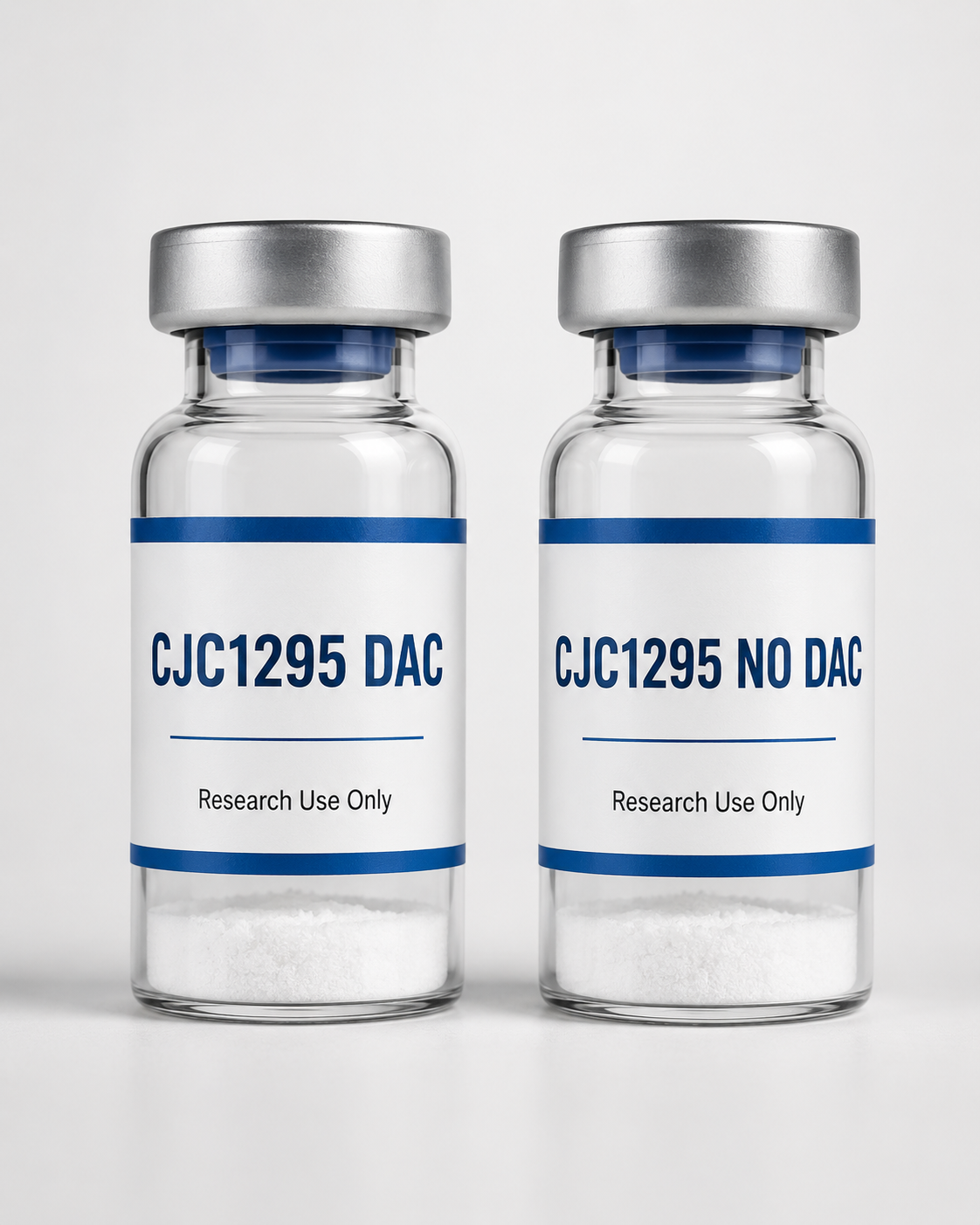
CJC-1295 without DAC is commonly discussed as a short-acting researched compound that may stimulate the body’s natural release of growth hormone. It is also one of the most misunderstood compounds in the growth hormone category.
Some sources call it CJC-1295 without DAC. Others use names such as Mod GRF 1-29, modified GRF 1-29, or no-DAC CJC-1295. These names are often treated as interchangeable, even though product labels and research papers do not always describe the same substance.
This guide explains what CJC-1295 without DAC is, how it may affect growth hormone signaling, and how it differs from the longer-acting DAC form. It also examines the proposed benefits, the popular ipamorelin combination, safety concerns, and the limits of current human research.
Important: CJC-1295 is not approved by the FDA for treating growth hormone deficiency, body composition, recovery, sleep problems, or age-related hormone decline. It is also prohibited in competitive sport under current World Anti-Doping Agency rules.

What Is CJC-1295 Without DAC?
CJC-1295 without DAC is described as a synthetic analog of growth-hormone-releasing hormone, commonly shortened to GHRH.
GHRH is naturally produced in the hypothalamus. It travels to the pituitary gland, where it signals specialized cells to produce and release growth hormone.
Natural GHRH is cleared quickly. Researchers have therefore developed modified versions that resist rapid breakdown and remain active longer than the natural hormone.
The phrase without DAC means that the molecule does not include the Drug Affinity Complex found in long-acting CJC-1295. Without this complex, it cannot bind to albumin in the same way as the DAC version. It is therefore expected to produce a shorter period of receptor stimulation.
Commercial sellers often use “CJC-1295 without DAC” as another name for Mod GRF 1-29. However, this terminology is not fully standardized.
FDA reviewers have evaluated CJC-1295 free base, CJC-1295 acetate, and several CJC-1295 DAC forms as separate substances. They also reported that they could not identify adequate studies establishing the pharmacological activity of CJC-1295 free base or CJC-1295 acetate without DAC.
This makes it important to confirm the exact substance being discussed. A name on a product label may not provide enough information to identify its structure, activity, or research history.

How Does CJC-1295 Without DAC Work?
CJC-1295 without DAC is intended to mimic the signaling activity of natural GHRH.
It is thought to bind to GHRH receptors on somatotroph cells in the anterior pituitary gland. Receptor activation increases intracellular cyclic AMP signaling, which may support the synthesis and release of growth hormone.
Growth hormone can then act on the liver and other tissues. One result is increased production of insulin-like growth factor 1, commonly called IGF-1.
IGF-1 is often used as a marker of growth hormone activity because growth hormone levels rise and fall throughout the day. A single growth hormone blood test may therefore provide an incomplete picture.
An important correction is that CJC-1295 does not primarily bind to the growth hormone secretagogue receptor, sometimes called the ghrelin receptor. That receptor is associated with compounds such as ipamorelin.
CJC-1295 and ipamorelin act through different signaling systems. This difference is the basis for combining them in experimental and clinic-marketed protocols.
Use code WELCOME26 for 20% OFF your first order
Does the No-DAC Form Preserve Natural GH Pulses?
The no-DAC form is often promoted as producing brief growth hormone pulses that more closely resemble the body’s natural pattern.
That claim is biologically plausible because a shorter-acting GHRH signal should create less continuous stimulation than an albumin-bound DAC formulation. However, direct human pharmacokinetic evidence for products sold as CJC-1295 without DAC remains limited.
Many online sources give a half-life of approximately 30 to 60 minutes. This estimate is often repeated without a clear human study supporting it.
Human trials have shown that long-acting CJC-1295 with DAC can raise average growth hormone and IGF-1 levels while preserving pulsatile growth hormone secretion. Those results involved a prolonged GHRH analog and should not automatically be applied to products labeled CJC-1295 without DAC.
The most accurate conclusion is that the no-DAC form is expected to provide shorter receptor stimulation. Its exact half-life and effects depend on the compound’s identity, formulation, purity, and biological activity.
CJC-1295 With DAC vs. Without DAC
The central difference between the two forms is the Drug Affinity Complex.
CJC-1295 with DAC contains a reactive chemical group designed to bind to albumin in the bloodstream. Albumin is a common blood protein with a long circulation time. Attaching the researched compound to albumin allows it to remain in the body much longer.
CJC-1295 without DAC does not have that albumin-binding feature. It is therefore discussed as a shorter-acting option.
| Feature | Without DAC | With DAC |
|---|---|---|
| Primary pathway | GHRH receptor | GHRH receptor |
| Drug Affinity Complex | No | Yes |
| Albumin binding | No intended DAC binding | Designed to bind albumin |
| Expected duration | Shorter acting | Long acting |
| Signal pattern | Brief receptor stimulation | Prolonged GH and IGF-1 stimulation |
| Human evidence | Very limited | Small human studies available |
| Common use in protocols | Often paired with ipamorelin | Often discussed as a stand-alone, longer signal |
In small studies of healthy adults, long-acting CJC-1295 increased growth hormone for several days. IGF-1 remained elevated even longer. The reported estimated half-life was approximately 5.8 to 8.1 days, depending on the dose.
These findings support the long duration of the DAC form. They do not establish the effects of CJC-1295 without DAC.
Does CJC-1295 acetate contain DAC?
Not necessarily.
The term acetate refers to a salt or counterion associated with the compound. It does not describe the Drug Affinity Complex.
Adding acetate does not automatically make CJC-1295 long acting. FDA documents list CJC-1295 acetate and CJC-1295 DAC acetate as separate substances.
A label that only says “CJC-1295 acetate” should not be assumed to contain DAC. The product documentation must clearly state whether the DAC modification is present.
Potential Benefits and Current Evidence
CJC-1295 without DAC is marketed for body composition, exercise recovery, sleep quality, energy, and age-related changes in growth hormone.
Most of these proposed benefits are based on the known functions of growth hormone and IGF-1. They are not supported by large clinical trials of CJC-1295 without DAC.
Body composition
Growth hormone influences fat metabolism and lean tissue. This has led to claims that stimulating growth hormone may support fat loss or muscle development.
However, increasing a hormone marker does not guarantee a visible or meaningful change in body composition.
The available human CJC-1295 studies focused mainly on changes in growth hormone and IGF-1 after the DAC formulation. They did not establish that CJC-1295 without DAC produces significant fat loss or muscle gain in healthy adults.
Research on growth hormone and athletic performance also provides a reason for caution. A systematic review found that growth hormone may increase lean body mass, but the available evidence did not show clear improvements in strength or exercise performance. Adverse effects were also more common.
Exercise recovery
Growth hormone plays a role in tissue growth and normal repair processes. For that reason, GH-releasing compounds are often marketed to people who train frequently.
There is not enough controlled human evidence to conclude that CJC-1295 without DAC speeds recovery from hard exercise, injuries, or surgery.
Reports of reduced soreness or faster recovery are largely based on personal experiences and clinic marketing. They should not be treated as proof of effectiveness.

Sleep quality
Natural growth hormone release is associated with deeper stages of sleep. Some people report changes in sleep after using compounds that affect the GH axis.
This does not mean CJC-1295 without DAC is an established sleep treatment. Controlled trials have not shown that it reliably treats insomnia, poor sleep quality, or sleep disorders.
Sleep changes may also be affected by training volume, stress, nutrition, medications, breathing problems, and existing health conditions.
Age-related growth hormone decline
Growth hormone and IGF-1 levels often change with age. This has created interest in using GH-axis compounds for “anti-aging” purposes.
Restoring a laboratory value to a younger range does not prove that aging has been slowed or reversed. Higher growth hormone and IGF-1 levels may also create risks when they are pushed beyond an appropriate range.
CJC-1295 without DAC has not been approved as an anti-aging treatment.
Why Is CJC-1295 Paired With Ipamorelin?
CJC-1295 without DAC is often paired with ipamorelin because the two compounds are intended to influence growth hormone through different receptors.
CJC-1295 is associated with the GHRH receptor. Ipamorelin is a selective growth hormone secretagogue that acts through the growth hormone secretagogue receptor.
Early pharmacology research found that ipamorelin could stimulate growth hormone release in laboratory and animal models.
The theory behind the combination is that CJC-1295 supplies a GHRH-like signal while ipamorelin provides a separate secretagogue signal. Activating both pathways may produce a larger growth hormone response than activating either pathway alone.
This is often described as a synergistic effect.
However, there is an important difference between receptor synergy and proven health outcomes. A larger hormone pulse does not establish that the combination will improve muscle growth, fat loss, sleep, recovery, or longevity.
FDA reviewers have noted the marketing of CJC-1295 and ipamorelin combinations, while also emphasizing the lack of adequate clinical evidence and the difficulty of identifying which CJC-1295 substance was used in some reports.
Read our complete guide to ipamorelin to learn more about the other part of this combination.
You can also compare CJC-1295 without DAC with sermorelin, another compound based on the active portion of GHRH.
Dosage and Administration
There is no FDA-approved dosage for CJC-1295 without DAC.
No FDA-approved CJC-1295 medication currently provides a standardized concentration, administration schedule, or treatment duration. Online protocols should not be treated as official dosing instructions.
The no-DAC form is commonly described as being administered by subcutaneous injection. Because it is expected to be shorter acting, online protocols often recommend more frequent administration than protocols involving CJC-1295 with DAC.
These schedules vary considerably. That variation reflects the lack of an approved formulation and adequate clinical trials.
Errors can also occur before a compound is administered. Potential problems include:
- Confusing DAC and no-DAC products
- Misreading the vial concentration
- Incorrect reconstitution
- Contamination during handling
- Poor storage conditions
- Inaccurate or incomplete labeling
- Using a product with the wrong identity or strength
A dosage calculator can perform mathematical conversions, but it cannot confirm that a vial contains the stated substance. It also cannot determine whether a compound is safe or appropriate for a person.

Blood Work and Monitoring
Because CJC-1295 is intended to affect the growth hormone pathway, IGF-1 is often discussed as a possible monitoring marker.
IGF-1 tends to remain more stable than growth hormone throughout the day. Growth hormone is released in pulses, making isolated measurements difficult to interpret.
Other areas that may be relevant to medical monitoring include fasting glucose, hemoglobin A1C, blood pressure, heart rate, swelling, and changes at injection sites.
Testing does not remove the risks associated with an unapproved compound. Normal baseline laboratory results also do not prove that a product is sterile, accurately labeled, or safe.
Anyone concerned about growth hormone deficiency should receive a complete medical evaluation. A low or normal IGF-1 result alone cannot diagnose every growth hormone disorder.
Side Effects and Safety Concerns
Available human safety information for CJC-1295 is limited. Much of it comes from small studies involving the longer-acting DAC form.
FDA reviewers have identified several concerns related to CJC-1295 products. These include possible immune reactions, aggregation, peptide-related impurities, and challenges confirming the identity of the active ingredient.
The FDA has also reported serious adverse events associated with CJC-1295, including an increased heart rate and a systemic vasodilatory reaction. Available clinical data remain limited.
Other reported or possible effects associated with growth hormone stimulation include injection-site reactions, flushing, headaches, swelling, fluid retention, and changes in glucose control.
The long-term risks of repeatedly stimulating the GH and IGF-1 pathway with CJC-1295 without DAC are not known.
Product quality creates an additional concern. A vial can show high HPLC purity while still having problems with concentration, sterility, endotoxins, degradation, or product identity.
A purity percentage alone does not prove that a product is suitable for human use.
How Research-Grade Material Is Produced
Research-grade CJC-1295-related material may be produced through solid-phase peptide synthesis.
During this process, amino acids are attached one at a time to a growing chain held on a solid resin. Temporary protective groups help prevent the wrong chemical reactions from occurring.
After the sequence is assembled, the material is removed from the resin and purified. Reverse-phase high-performance liquid chromatography is commonly used to separate the desired product from impurities.
Mass spectrometry can then help confirm whether the material has the expected molecular mass.
Research-focused quality testing may also examine:
- HPLC purity
- Molecular identity
- Peptide content
- Water content
- Residual solvents
- Counterions
- Endotoxins
- Sterility
- Truncated or damaged sequences
These tests answer different questions. HPLC may estimate purity, while mass spectrometry helps evaluate identity. Sterility and endotoxin tests assess separate safety concerns.
No single result provides a complete picture of quality.
FDA Status and Availability
CJC-1295 is not an FDA-approved drug.
Compounded drugs are also not FDA approved. They do not go through the same premarket review for safety, effectiveness, and manufacturing quality as approved medications.
FDA documents from May 14, 2026, list CJC-1295 among substances whose nominations for the Section 503A bulks list were withdrawn. This does not mean the compound was approved, cleared of safety concerns, or broadly authorized for compounding.
Products sold online with “research use only” labels are not approved for human treatment. Their ingredients, concentrations, sterility, and storage history may be difficult to verify.
For the latest regulatory information, review the FDA’s bulk drug substances used in compounding page.
Is CJC-1295 Banned in Competitive Sport?
CJC-1295 is prohibited under the World Anti-Doping Agency’s 2026 Prohibited List.
WADA includes CJC-1295 among growth hormone-releasing factors. Ipamorelin is also prohibited as a growth hormone secretagogue.
These restrictions apply at all times, not only during competition. Athletes may face sanctions even when a compound is recommended or supplied by a clinic.
Tested athletes should review the current WADA Prohibited List and their sport’s rules before using any supplement, medication, or researched compound that may affect growth hormone.
Frequently Asked Questions
Is CJC-1295 without DAC the same as Mod GRF 1-29?
The names are commonly used interchangeably by commercial sellers. However, naming is not standardized, and FDA documents evaluate different CJC-1295-related substances separately.
Confirming the exact sequence and chemical form is more reliable than relying only on the product name.
How long does CJC-1295 without DAC last?
It is expected to be much shorter acting than the DAC version. Online sources frequently claim a half-life of 30 to 60 minutes, but adequate human pharmacokinetic studies supporting a precise figure are lacking.
Is CJC-1295 without DAC the same as sermorelin?
No. Both are based on the active region of GHRH, but they may contain different amino-acid modifications.
Sermorelin is generally described as GHRH 1-29. Products marketed as Mod GRF 1-29 typically contain substitutions intended to improve resistance to enzymatic breakdown.
Does acetate make CJC-1295 last longer?
Acetate is a salt form. It is not the Drug Affinity Complex and does not create the same albumin-binding effect as DAC.
Is the no-DAC form safer because it clears faster?
A shorter expected duration may make exposure easier to stop than with a multi-day formulation. That does not establish that it is safe.
Reliable safety comparisons between DAC and no-DAC versions have not been established through large human trials.
Does CJC-1295 without DAC build muscle?
There is not enough human evidence to conclude that it produces meaningful muscle growth in healthy adults.
Its proposed muscle-related effects are based mainly on its intended influence on growth hormone and IGF-1.
Why is it combined with ipamorelin?
The two compounds are intended to act through different receptors involved in growth hormone release. This may create a stronger hormonal response, but clinical benefits from the combination have not been established.
Bottom Line
CJC-1295 without DAC is commonly described as a short-acting GHRH analog. It is often marketed under the name Mod GRF 1-29, although the terminology is not always consistent.
It differs from CJC-1295 with DAC because it lacks the albumin-binding Drug Affinity Complex. The DAC version remains active for several days, while the no-DAC form is expected to create shorter receptor stimulation.
The most important limitation is the evidence.
Human studies of CJC-1295 have mainly examined the long-acting DAC form and measured changes in growth hormone or IGF-1. Those findings do not prove that CJC-1295 without DAC improves muscle growth, fat loss, exercise recovery, sleep quality, or healthy aging.
The ipamorelin combination has a reasonable biological theory because the two compounds target different receptors. Strong human outcome studies on the combination remain absent.
CJC-1295 is not FDA approved, carries product-quality and safety concerns, and is prohibited in competitive sport.
References
Teichman SL, et al. Prolonged stimulation of growth hormone and IGF-1 secretion by CJC-1295 in healthy adults. Journal of Clinical Endocrinology & Metabolism. 2006.
Ionescu M, Frohman LA. Pulsatile secretion of growth hormone persists during continuous stimulation by CJC-1295. Journal of Clinical Endocrinology & Metabolism. 2006.
Raun K, et al. Ipamorelin, the first selective growth hormone secretagogue. European Journal of Endocrinology. 1998.
U.S. Food and Drug Administration. CJC-1295-related bulk drug substances and Pharmacy Compounding Advisory Committee materials.
World Anti-Doping Agency. The 2026 Prohibited List.