
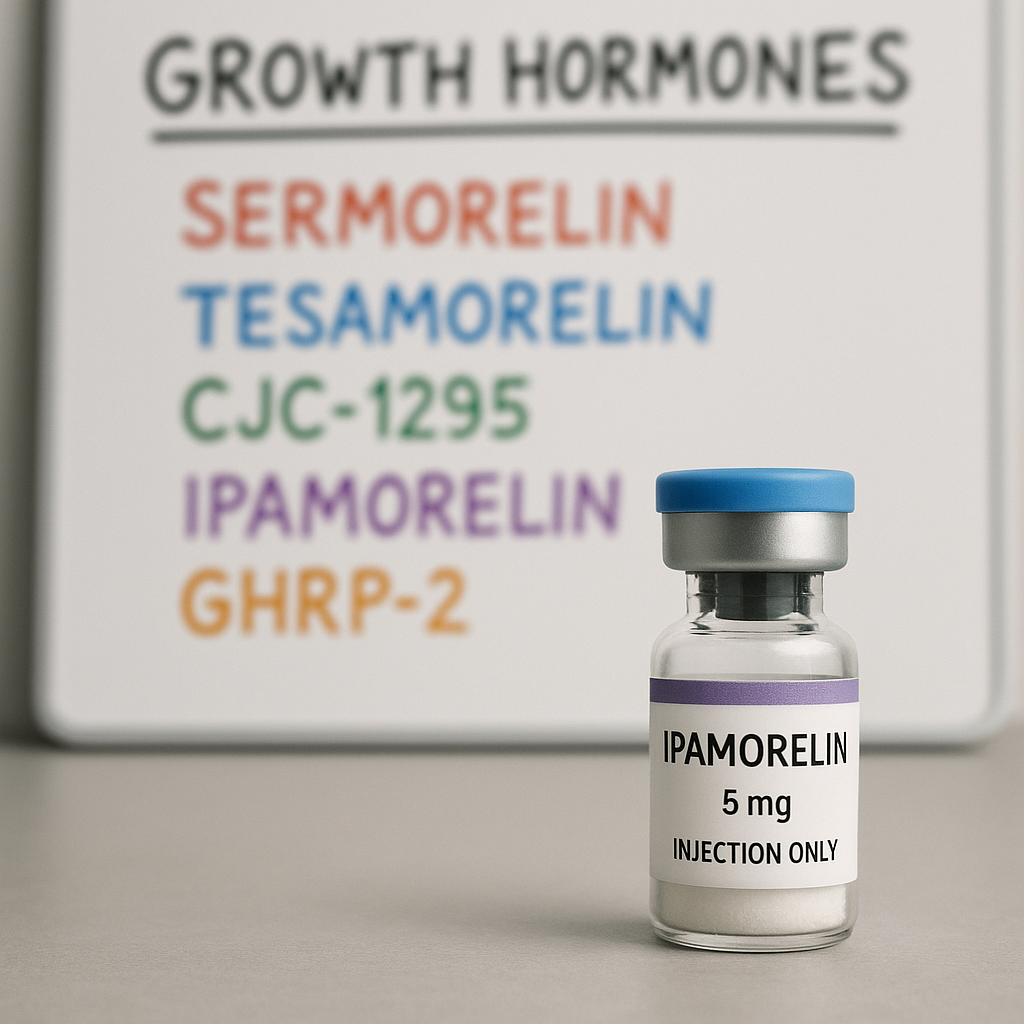
Ipamorelin often appears in conversations about recovery, sleep, lean mass, and growth hormone support. Those claims can sound simple, but the evidence is not. Understanding what ipamorelin does, what researchers have measured, and what remains unknown can help you separate a biological effect from a proven performance benefit.

Ipamorelin can trigger growth hormone release, but that mechanism does not prove better recovery, sleep, or body composition.*
1. Ipamorelin Signals the Body to Release Growth Hormone
Ipamorelin is a synthetic chain of five amino acids. It acts as an agonist at the ghrelin receptor, also called the growth hormone secretagogue receptor. This signal can prompt the pituitary gland to release stored growth hormone.
That is different from taking recombinant growth hormone. Ipamorelin does not replace growth hormone directly. It stimulates a pathway involved in the body’s own hormone release.
An early human study found that intravenous ipamorelin caused a single growth hormone pulse. The response peaked within the first hour and then declined. The study measured hormone release and how the compound moved through the body. It did not test muscle growth, fat loss, sleep quality, or athletic recovery.
GET IPAMORELIN -> WELCOME26
2. Its Selectivity Is Real, but the Meaning Is Limited
Ipamorelin gained attention because early research suggested a more selective hormone signal than older growth hormone secretagogues. In animal experiments, it increased growth hormone without the same rise in ACTH or cortisol seen with some related compounds.
That finding helps explain why commercial pages describe ipamorelin as a “cleaner” option. The source page also connects it with recovery, body composition, and sleep.
However, selectivity does not prove safety. It also does not prove that someone will recover faster, sleep better, gain muscle, or lose fat. A compound can target one hormone pathway while still causing unwanted effects elsewhere.
3. Recovery, Sleep, and Fat-Loss Claims Exceed the Evidence
Growth hormone and IGF-1 take part in tissue growth, metabolism, and repair. That biological role makes ipamorelin sound relevant to athletes. Yet a plausible mechanism is not the same as a proven result.
There are no strong, long-term trials showing that ipamorelin improves recovery, strength, body composition, or sleep in healthy active adults. The FDA’s scientific review found limited evidence of effectiveness and major gaps in human safety data.
Much of the discussion online relies on hormone changes, animal studies, clinic experience, or user reports. These sources can help generate research questions, but they cannot replace controlled human outcome studies.
The best-known later-stage human trial studied postoperative ileus after bowel surgery, not athletic performance. Researchers found no significant difference between ipamorelin and placebo for the main or secondary effectiveness measures.
For recovery strategies with stronger everyday value, read Recovery Is Training and the 24-Hour Recovery Blueprint.
4. Combining Ipamorelin With CJC-1295 Adds Uncertainty
Ipamorelin is often discussed with CJC-1295 because the two compounds act through different growth hormone pathways. Ipamorelin targets the ghrelin receptor. CJC-1295 acts through the growth hormone-releasing hormone receptor.
The theory is that activating both pathways may create a larger or longer growth hormone signal. However, that does not prove that the combination improves recovery, sleep, fat loss, or muscle growth.
Combining compounds also makes it harder to identify which substance caused a benefit or unwanted effect. It may increase the risk of interactions or excessive hormone changes.
The FDA has separately reported limited clinical evidence and serious adverse events associated with CJC-1295. These included increased heart rate and a systemic vasodilatory reaction.
5. Ipamorelin Is Not an FDA-Approved Treatment
There is no FDA-approved ipamorelin drug for recovery, sleep, body composition, growth hormone deficiency, or postoperative ileus. The source page also identifies it as a research compound that is not FDA approved.
A compounded product is not the same as an FDA-approved product. FDA-approved drugs undergo a formal review of safety, effectiveness, quality, manufacturing, and labeling for a defined medical use.
Compounded drugs do not pass through that same premarket approval process. They must instead meet specific conditions under federal compounding laws.
The FDA reviewed ipamorelin free base and ipamorelin acetate for possible compounding use. Its scientific evaluation found limited effectiveness evidence, incomplete product-characterization data, and unresolved safety concerns. The review weighed against adding the substances to the Section 503A Bulks List.
For a broader explanation of the difference between compounding access and formal approval, read What FDA Peptide Votes Actually Change.
6. Safety Gaps Matter More Than a Mild-Side-Effect List
Commercial summaries often focus on headaches, flushing, lightheadedness, or injection-site reactions. Those effects may occur, but they do not describe the full uncertainty surrounding ipamorelin.
The FDA has raised concerns about aggregation, product impurities, immune reactions, and the difficulty of fully characterizing injectable ipamorelin products. It also found no safety data for the proposed subcutaneous route in the materials it reviewed.
In a clinical study using intravenous ipamorelin after bowel surgery, reported events included low potassium, insomnia, high blood glucose, nausea, vomiting, abdominal swelling, and two deaths. The FDA noted that it was unclear whether the deaths were caused by ipamorelin.
The growth hormone and IGF-1 pathway can also affect glucose regulation. People should not assume that stimulating the body’s own growth hormone makes a compound automatically safer than administering growth hormone directly.
7. Competitive Athletes Should Treat It as Prohibited
Ipamorelin is included among the growth hormone secretagogues prohibited by the World Anti-Doping Agency. The 2026 Prohibited List applies the ban at all times, not only during competition.
That matters for professional, collegiate, Olympic, and other tested athletes. A clinic prescription or compounded label does not automatically create an anti-doping exemption.
Athletes should check the rules for their sport and speak with their medical and anti-doping teams before using any hormone-active compound. Products with incomplete or inaccurate labels may also create testing risks.
How to Evaluate an Ipamorelin Claim
Before accepting an online claim, ask these questions:
- Was the result measured in humans or animals?
- Were the subjects healthy athletes or patients with a medical condition?
- Did the study measure a meaningful outcome or only a hormone marker?
- Was ipamorelin tested alone or inside a multi-compound stack?
- Was the route of administration the same as the product being discussed?
- How long did the research last?
- Was the product FDA approved, compounded, or sold only for research?
These questions expose a common evidence gap. A study may show that ipamorelin raises growth hormone, while a marketing claim says it improves recovery. Those are not equal findings.
Read our full free Peptide Guide here
Conclusion
Ipamorelin can stimulate growth hormone release, and early research supports its selective action at the ghrelin receptor. That is the clearest part of the evidence.
The larger claims about faster recovery, better sleep, improved body composition, and stronger performance remain uncertain. Human outcome data are limited, long-term safety has not been established, and the FDA has identified serious gaps involving effectiveness, impurities, immune risk, and injectable use.
For competitive athletes, the anti-doping issue is direct: ipamorelin is prohibited. The most useful approach is to separate mechanism from outcome, marketing from approval, and short-term hormone changes from proven long-term benefits.
Review the FDA’s current compounding safety information before relying on commercial claims.
Educational content only. This article does not provide medical advice, diagnosis, dosing, or treatment recommendations.