
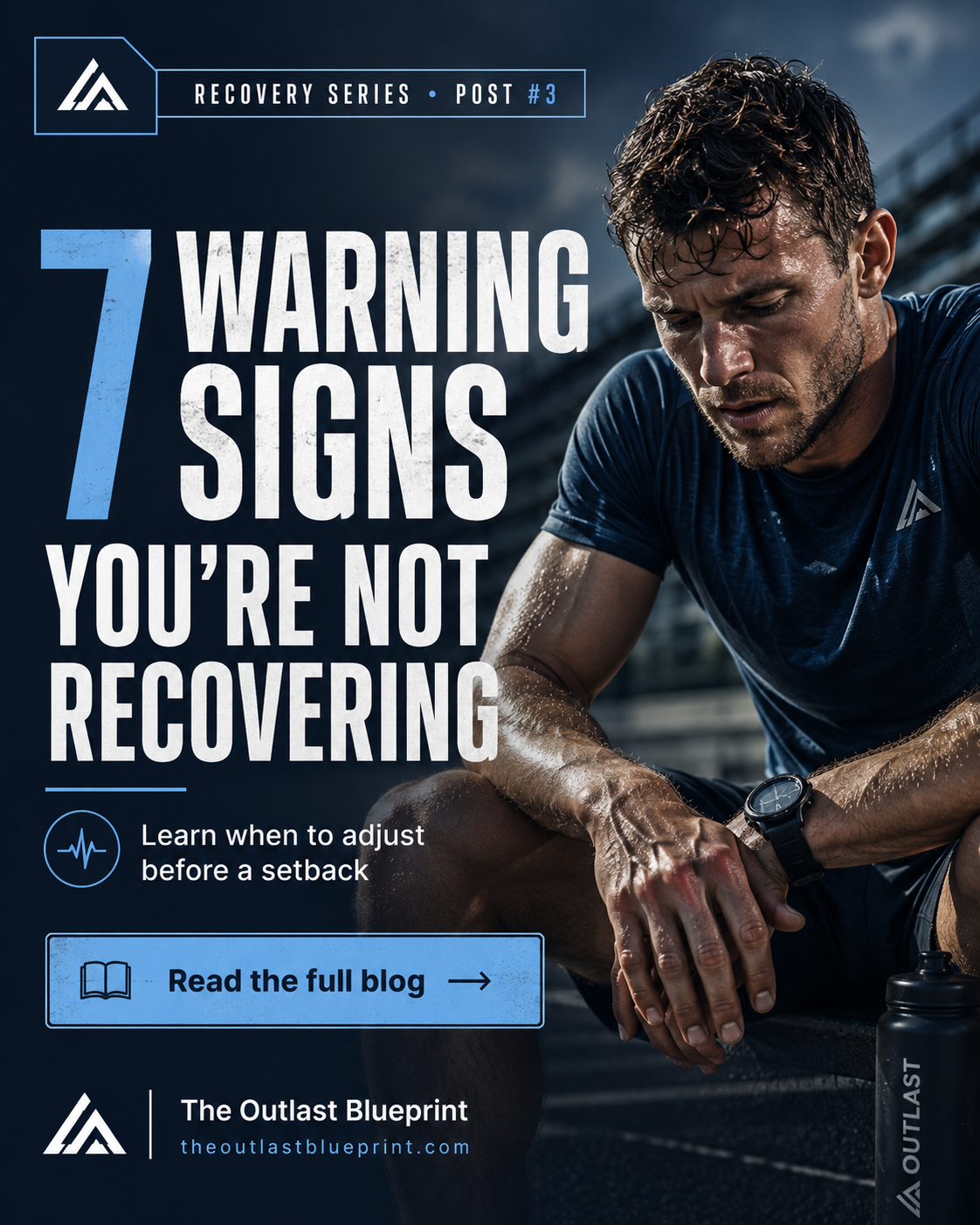
7 Recovery Warning Signs You Should Never Ignore
High performers are skilled at overriding discomfort.
That ability can be useful. It helps you finish difficult workouts, stay composed under pressure, and continue when conditions are less than ideal.
But the same mindset can become a liability when you ignore every signal your body sends.
There is a difference between the discomfort created by productive effort and the warning signs of declining recovery. Learning that difference can prevent one difficult week from becoming a lost month.

This is Post #3 in our Recovery Series. Read [Recovery Is Training(https://theoutlastblueprint.com/blog/recovery-is-training)]and follow it with the 24-Hour Recovery Blueprint.
Your Body Usually Whispers Before It Shouts
A major setback can feel sudden.
In many cases, however, the warning signs began days or weeks earlier. The athlete simply kept overriding them.
One bad session does not mean your training plan is failing. A stressful day, poor sleep, or a demanding week can temporarily lower performance.
The concern begins when several warning signs appear together or continue getting worse.
Pay attention to changes such as:
- Performance declining across several workouts.
- Soreness lasting longer than expected.
- A repeated change in movement or technique.
- Unusual heaviness during normally manageable sessions.
- Irritability or a loss of enthusiasm for training.
- Difficulty sleeping despite feeling exhausted.
- Pain becoming sharper, more localized, or more intense.
- Needing more effort to produce results that once felt routine.
None of these signs proves that something serious is wrong.
The pattern matters more than one isolated symptom.
A single difficult workout happens.
Several declining workouts deserve attention.
1. Your Performance Keeps Declining
Every athlete has poor workouts.
The problem is not one disappointing session. The problem is a steady decline without a clear reason.
Perhaps your normal working weight suddenly feels much heavier. Your usual running pace may require more effort. You might also struggle to complete conditioning sessions that were manageable two weeks earlier.
Performance can decline because of many factors:
- Inadequate sleep.
- High training volume.
- Poor nutrition.
- Dehydration.
- Emotional stress.
- Illness.
- Insufficient recovery time.
Do not panic after one weak performance. Look at the larger trend.
When output continues falling across several sessions, your body may be asking for an adjustment.
2. Soreness Is No Longer Improving
Normal training soreness should gradually improve.
It may feel uncomfortable, but it should not become sharper or more severe each day. It should also not force you to change how you move.
Pay attention when soreness:
- Lasts longer than usual.
- Returns every time you train.
- Becomes focused in one small area.
- Changes your walking, running, or lifting pattern.
- Becomes painful during ordinary daily activities.
The goal is not to become afraid of soreness. The goal is to recognize when normal discomfort begins behaving differently.
Persistent or worsening pain should not be treated as a test of toughness.

3. Your Movement Quality Is Breaking Down
Fatigue changes how the body moves.
As your energy drops, you may shorten your range of motion, shift weight away from one side, or rely on momentum. You might also rush through positions that normally remain controlled.
Continuing to chase volume under these conditions can reinforce compensation rather than productive technique.
Set your movement standards before the workout begins.
Decide what acceptable technique looks like. Identify the signs that will cause you to lower the weight, reduce the pace, or end the set.
These decisions are easier to make before fatigue and pride take control.
Your final repetitions should challenge you. They should not require you to abandon every standard that made the exercise valuable.
4. Your Warm-Up Feels Unusually Difficult
A warm-up provides more than physical preparation. It also gives you information.
Notice how your body responds during the first few minutes.
Ask yourself:
- Do normal movements feel unusually stiff?
- Does your heart rate rise faster than expected?
- Is your coordination less consistent?
- Does discomfort improve as you move?
- Does the planned training load feel realistic today?
Sometimes the body simply needs more time to prepare. After a longer warm-up, you may feel ready to train normally.
Other times, the warm-up confirms that your recovery is behind.
Use that information. Do not ignore it because the workout was already written.
5. You Feel Exhausted but Cannot Sleep
Sleep is one of the strongest foundations of recovery.
A difficult training block may increase your need for sleep. But high stress can also make quality sleep harder to achieve.
You may feel physically exhausted while your mind remains alert. You might wake repeatedly, struggle to fall asleep, or feel unrefreshed in the morning.
One poor night is not a crisis.
Several poor nights can affect:
- Reaction time.
- Decision-making.
- Motivation.
- Coordination.
- Training output.
- Perceived effort.
When sleep begins falling apart, adding more training stress may not produce the result you want.
Review your schedule, evening routine, training time, caffeine intake, and total workload. Recovery cannot keep pace when the body never receives enough time to reset.

6. Your Motivation Has Changed
Low motivation is often dismissed as laziness.
That is not always accurate.
Athletes who usually enjoy training may suddenly feel emotionally drained, irritable, or disconnected from the process. They may begin dreading sessions that once felt rewarding.
Motivation naturally changes from day to day. You will not feel excited before every workout.
But a sustained loss of enthusiasm can be useful information, especially when it appears with poor sleep, declining performance, and persistent soreness.
Ask whether you are avoiding normal effort or experiencing a broader pattern of exhaustion.
Those are not the same situation.
7. You Need More Effort for the Same Result
A key recovery warning sign appears when familiar work begins demanding much more effort.
The weight has not changed, but it feels heavier.
The route has not changed, but the pace feels harder.
The workout has not changed, but you need more mental energy to finish it.
This increase in perceived effort may signal that your current workload is exceeding your ability to recover.
Do not judge yourself only by whether you completed the session. Consider how much the session cost you.
Finishing every workout while your performance steadily declines is not proof that the plan is working.
Stop Waiting for Complete Failure
Many athletes only modify training when they can no longer perform.
By then, the adjustment may require far more time.
You do not need to wait until pain prevents movement or exhaustion destroys your motivation. Early adjustments can be small.
You might:
- Reduce the number of working sets.
- Lower the training intensity.
- Replace impact work with a lower-impact option.
- Take an additional recovery day.
- Focus on technique instead of output.
- Remove optional conditioning.
- Seek professional evaluation for persistent symptoms.
An adjustment is not the same as quitting.
It is an attempt to protect momentum.
A lighter session today may preserve the quality of your training later in the week. An additional recovery day may prevent a minor concern from becoming a longer interruption.
Use Data Without Becoming Controlled by It
Wearable devices and recovery scores can provide helpful context.
They should not replace your judgment.
A single score cannot explain your complete condition. Sleep trackers can be imperfect. Heart-rate data can be affected by stress, hydration, temperature, and many other factors.
Combine objective information with your experience.
Ask:
- How did I sleep?
- How does my warm-up feel?
- Is my output close to normal?
- Is my coordination consistent?
- Do I feel willing to train?
- Is discomfort improving, stable, or worsening?
- Have several recovery signs changed at the same time?
Look for agreement between multiple signals.
A low recovery score paired with normal energy and strong performance may not require a major change. A normal score paired with sharp pain and worsening movement should not be ignored.
Data should support awareness, not replace it.
Respond Early and Return Stronger
The goal of monitoring recovery is not to become afraid of effort.
The goal is to apply effort with greater precision.
You are not protecting yourself from hard training. You are protecting your ability to continue training hard.
Sometimes you will assess the situation, complete your warm-up, and realize you are ready to perform.
Other times, you will recognize that pushing harder would serve your ego more than your long-term objective.
Both decisions can demonstrate discipline.
When symptoms remain persistent, sharp, or progressively worse, consider speaking with a qualified healthcare or sports medicine professional. The Sports Medicine Today resource can help you learn more about common sports injuries and when professional evaluation may be appropriate.
Bottom Line
The strongest performers are not those who ignore every warning sign.
They are the ones who recognize patterns early enough to respond.
One difficult workout is normal. A repeated decline in performance, movement quality, sleep, motivation, or soreness deserves attention.
Listen while your body is whispering.
A small adjustment today may be what keeps you training tomorrow.